
Digital Signature vs Electronic Signature: What’s the Difference?
Summary
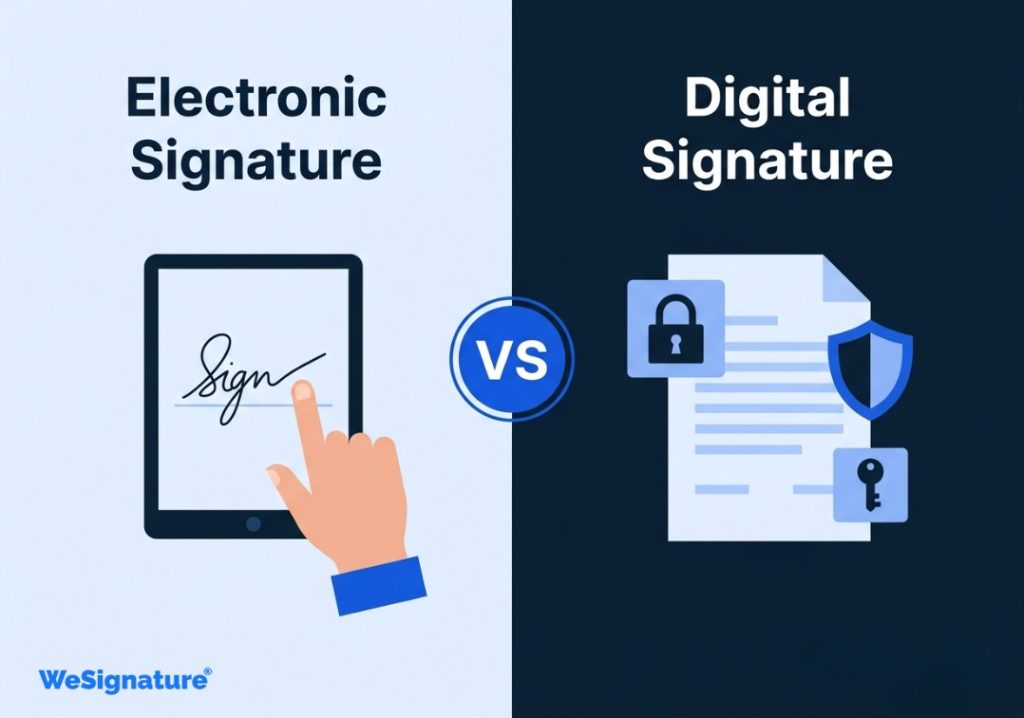
Digital signatures and electronic signatures both enable people to sign documents without ink, but they offer different levels of security, authentication, and legal safeguards. This guide explains the technologies behind each signature type, compares their benefits and risks, and helps readers decide when to use a simple e-signature and when to choose the cryptographic protection of a digital signature.
Have you ever clicked an “I agree” box at the end of an online purchase, drawn your name with a finger on a tablet, or typed your initials into a form? If so, you’ve already used an electronic signature. Electronic signing tools are everywhere: they accelerate contract processing, streamline workflows, and reduce paper waste.
Yet many people still confuse electronic signatures with digital signatures, even though these technologies are not the same. Understanding the difference matters because organisations must balance convenience with security and regulatory compliance.
In the United States and worldwide, laws such as the E-SIGN Act and eIDAS recognise electronic signatures, but regulations often require more rigorous identity checks for high-stakes documents. As the digital-signature market surges toward an estimated $35 billion by 2029, it’s important to know which type of signature suits your situation.
Recent statistics at a glance
- Explosive growth of e-signatures: In just five years, the number of global electronic-signature transactions jumped from 198 million to 4,754 million. This surge reflects the rapid adoption of digital document workflows across industries.
- The cost of paper is staggering: U.S. businesses spend about $8 billion a year managing paper records and up to $120 billion on paper documents overall. Replacing paper with e-signatures eliminates filing, shipping, and storage costs.
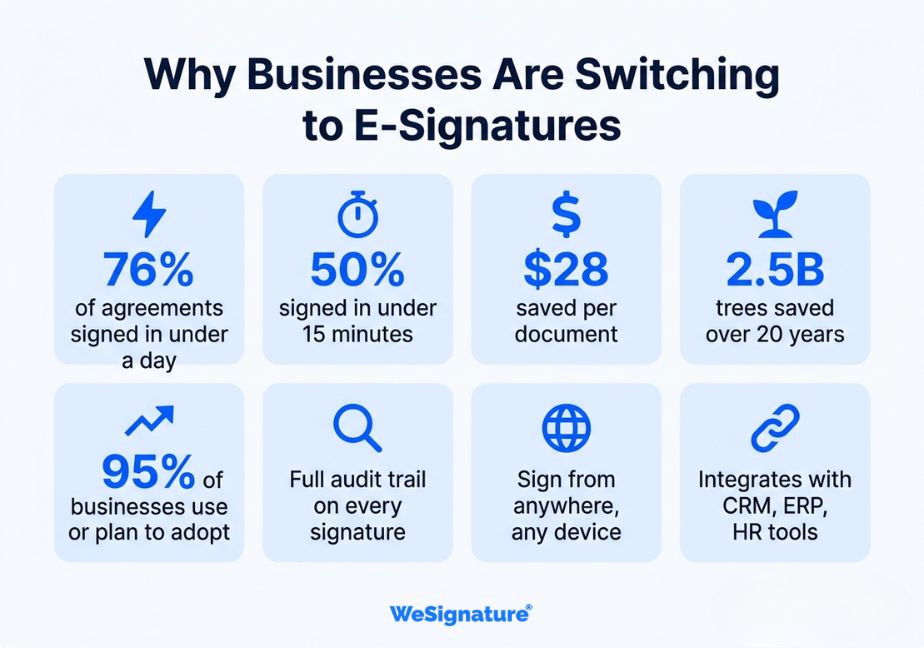
- Widespread adoption: Surveys show that 95 % of businesses are already using or plan to adopt e-signature technology. A separate study found that 77 % of North American business owners view electronic signatures as essential for business resiliency.
- Time saved: Up to 76 % of agreements are completed in less than a day, and 50 % in under 15 minutes when using e-signatures. Faster turnaround improves cash flow and customer satisfaction.
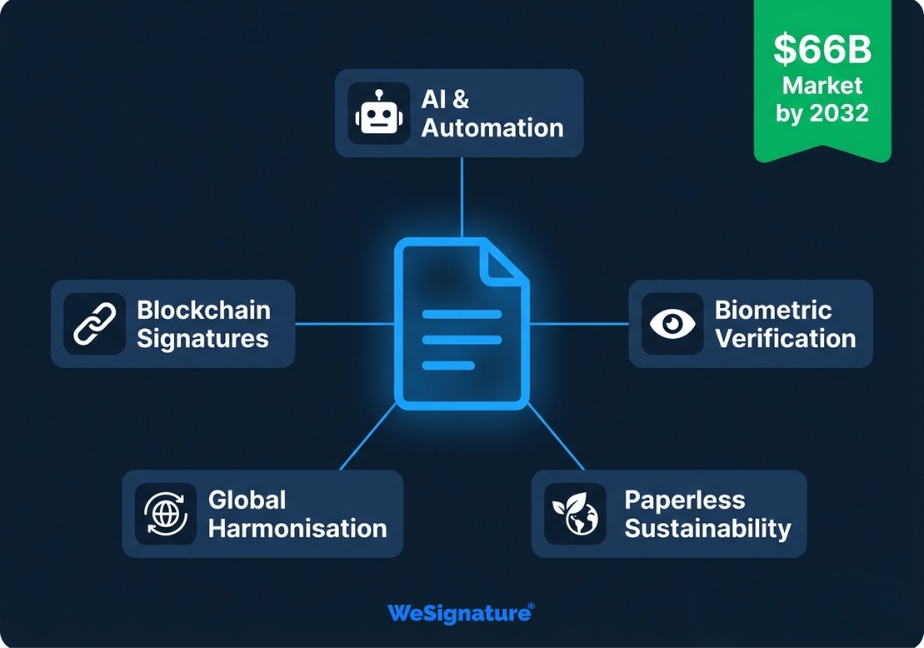
- Massive market growth: Analysts project that the global digital-signature market will exceed $35 billion by 2029 and could reach $66 billion by 2032, driven by strong demand for secure, compliant signing solutions.
What is an electronic signature?
An electronic signature (often shortened to e-signature) refers to data in electronic form that is logically associated with other data and used by the signatory to sign the associated data. It can be as simple as typing a name, drawing a signature with a stylus, or clicking a checkbox to indicate assent.
Electronic signatures have the same legal standing as handwritten signatures when they comply with relevant regulations, such as the U.S. ESIGN Act or Europe’s eIDAS regulation. Importantly, an electronic signature is a legal concept and encompasses many technologies; it does not necessarily involve cryptographic protection.
Under the U.S. E-SIGN Act, an electronic signature is defined as
An electronic sound, symbol, or process, attached to or logically associated with a contract or other record and executed or adopted by a person with the intent to sign the record.
The law also states that electronic records and signatures may satisfy statutes requiring written information, provided the consumer consents to electronic delivery. These definitions make clear that intent to sign is crucial—clicking an “I agree” button counts as a signature only when the signer understands they are signing and agrees to do so.
What is a digital signature?
A digital signature is a specific type of electronic signature that uses cryptographic techniques to verify the authenticity and integrity of a digital message or document. In cryptography, a digital signature is a mathematical scheme for verifying the authenticity of digital messages or documents.
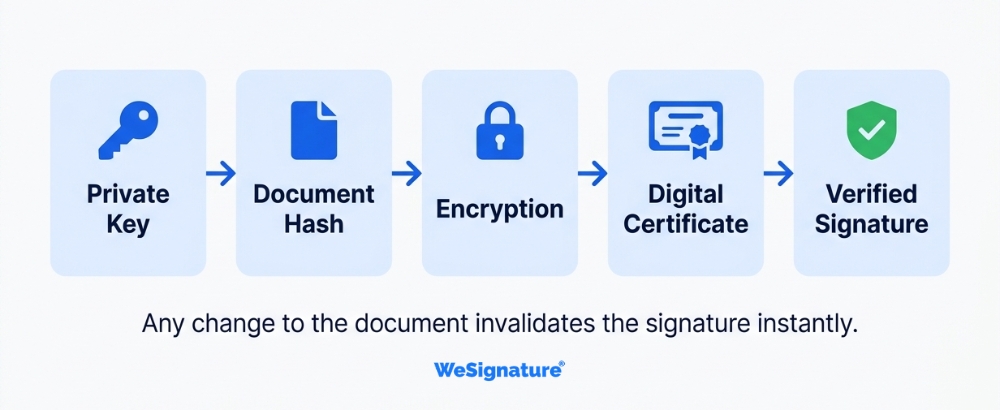
Digital signatures rely on public-key cryptography: a signer uses a private key to generate a signature, and anyone can use the corresponding public key to verify that the signature came from that signer and that the document hasn’t been altered.
Unlike generic e-signatures, digital signatures create a unique cryptographic fingerprint of the document (a hash) and attach it to the document along with a digital certificate issued by a trusted certificate authority (CA). This certificate binds the signer’s identity to a public key. Verification algorithms check the signature to ensure:
- The signature was created by the holder of the corresponding private key.
- The document has not been modified since it was signed (tamper-evident).
- The signer’s identity is authenticated through a digital certificate and audit trail.
Because digital signatures use encryption and certificates, they provide non-repudiation, meaning the signer cannot credibly deny having signed the document, while generic e-signatures typically offer only weaker evidence of intent. Digital signatures are therefore often required for regulated industries, government filings, and high-value contracts.
Types of electronic signatures
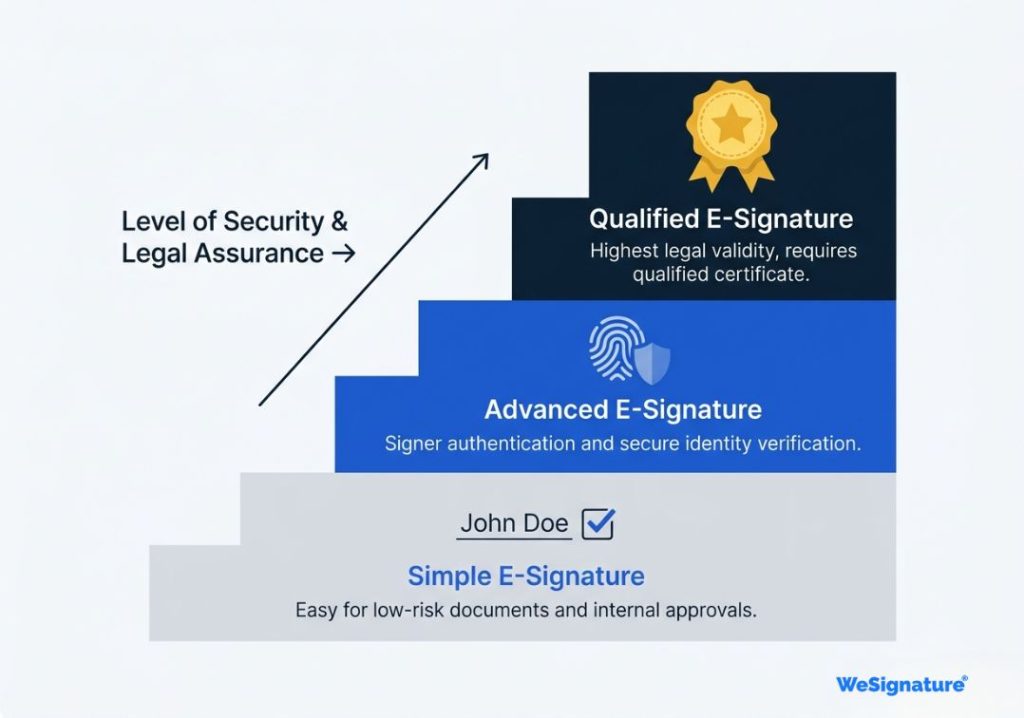
Electronic signatures can be implemented at various levels of assurance. In Europe, eIDAS distinguishes between simple, advanced, and qualified electronic signatures:
- Simple electronic signature: Any electronic data used to indicate a person’s intent to sign (e.g., typed names, scanned signature images). It provides minimal security and relies primarily on intent.
- Advanced electronic signature: Requires that the signer be uniquely identified and have sole control over the signature creation device, and that any changes to the signed data be detectable. These signatures often use additional authentication methods (passwords, multi-factor authentication) and provide audit trails.
- Qualified electronic signature: A specific type of advanced signature created using a qualified signature creation device and a certificate issued by a qualified trust service provider. Under eIDAS, qualified signatures have the same legal effect as handwritten signatures and offer the highest evidentiary value.
In the U.S., the E-SIGN Act does not distinguish between advanced or qualified signatures, but many providers implement similar tiers (simple click-to-sign, authenticated e-signature, and certificate-based digital signature) to meet industry-specific requirements.
Key components of digital signatures
Digital signatures rely on several cryptographic components:
- Public Key Infrastructure (PKI): A system of digital certificates, certificate authorities, and registration authorities that binds public keys to identities and manages key issuance and revocation.
- Private key: A secret key held securely by the signer. The private key is used to encrypt (sign) a hash of the document.
- Public key: A key corresponding to the private key. Anyone can use the public key to verify the signature.
- Hash function: Generates a fixed-length “fingerprint” of the document. When the document changes, its hash changes, which makes tampering evident.
- Digital certificate: Issued by a trusted Certificate Authority, it verifies the signer’s identity and binds it to their public key.
These components work together to ensure that digital signatures are tamper-evident and that signatures cannot be forged without the private key.
Legal and regulatory framework
United States
The E-SIGN Act of 2000 established that electronic signatures cannot be denied legal effect solely because they are electronic. It allows electronic records to satisfy any statute requiring information to be in writing, provided the consumer consents to electronic delivery.
The law defines an electronic signature as any electronic sound, symbol, or process executed with the intent to sign. It also sets out requirements for consumer disclosures: organisations must inform signers of their right to receive paper records, how to withdraw consent, and any hardware or software requirements.
Complementing the E-SIGN Act, the UETA has been adopted by most U.S. states. UETA establishes that a signature or record may not be denied legal effect solely because it is in electronic form and provides guidance on the formation and retention of electronic contracts. Together, E-SIGN and UETA ensure that electronic and digital signatures have the same legal status as ink signatures in nearly all contexts.
European Union
The eIDAS Regulation (Regulation (EU) No 910/2014) provides a framework for electronic identification and trust services in the EU. It recognises simple, advanced, and qualified electronic signatures and specifies that qualified electronic signatures must be accepted as equivalent to handwritten signatures.
eIDAS is technology-neutral but requires that qualified signatures be based on qualified certificates issued by accredited trust service providers. The regulation promotes cross-border recognition of signatures, enabling businesses and citizens to sign documents across EU member states without additional formalities.
Global standards
Many countries have adopted laws similar to E-SIGN and eIDAS, often based on the UNCITRAL Model Law on Electronic Signatures. Standards bodies such as NIST and ETSI publish technical standards (e.g., XAdES, PAdES) that define how digital signatures should be created, validated, and preserved. These standards ensure interoperability and help courts trust digital evidence.
Key differences between electronic and digital signatures
Although all digital signatures are electronic signatures, not all electronic signatures are digital signatures. The differences lie in technology, security, authentication, and legal assurance.
Technology and security
- Electronic signatures: Encompass any method of signing electronically. They may be simple (e.g., typing a name), moderately secure (e.g., requiring email authentication), or advanced. Security varies widely depending on the platform. Basic e-signatures may not include tamper detection or identity verification.
- Digital signatures: Always involve encryption, hashing and digital certificates. They produce a tamper-evident seal and strong evidence of the signer’s identity. The cryptographic algorithms and PKI infrastructure make it practically impossible to alter the document without invalidating the signature.
Authentication and identity
- Electronic signatures: May or may not include authentication. Some platforms simply capture IP addresses or email addresses, while more robust implementations use multi-factor authentication and audit trails to link the signature to the signer.
- Digital signatures: Always require the signer to possess a certificate issued by a trusted authority. This certificate contains the signer’s public key and identity details. Verification checks the certificate chain to ensure validity and may include time-stamping. Thus, digital signatures provide higher assurance of signer identity.
Evidence and non-repudiation
- Electronic signatures: Provide evidence of intent but may be easier to dispute if authentication or audit trails are weak. Many jurisdictions accept them as legally binding, but their probative value in court depends on platform features and compliance with applicable laws.
- Digital signatures: Offer strong non-repudiation. The signature is mathematically linked to the signer’s private key, and any change to the document invalidates the signature. Courts generally regard digital signatures as carrying higher evidentiary weight.
Ease of use and cost
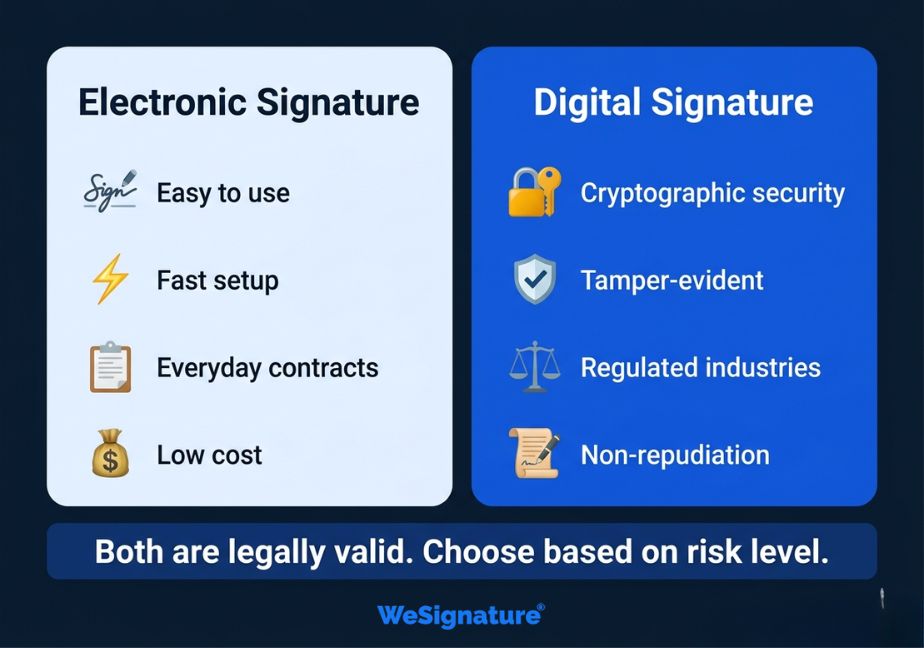
- Electronic signatures: Typically easier to implement and use. Many platforms offer free or low-cost e-signature services that allow users to type, draw or upload signature images. They suit everyday business contracts, HR documents and customer agreements.
- Digital signatures: Slightly more complex because users must obtain and manage digital certificates and, in some cases, hardware tokens. Certificate issuance and PKI management can incur additional costs. Digital signatures are therefore often reserved for high-risk transactions, regulated industries and government filings.
Use cases
- Electronic signatures: Ideal for sales proposals, non-disclosure agreements (NDAs), HR documents, internal approvals, and routine agreements. They provide sufficient security for most everyday transactions and dramatically reduce turnaround time.
- Digital signatures: Necessary when regulations demand strong proof of identity and tamper detection—such as government forms, financial services, healthcare records, court filings and intellectual property registrations. They are also valuable when parties expect disputes and need higher evidentiary assurance.
Compliance requirements
- Electronic signatures: Must meet the consent, intent, opt-out and record-retention requirements laid out in the E-SIGN Act and UETA. For example, signers must be informed of their right to withdraw consent and to receive paper copies.
- Digital signatures: Must meet all electronic-signature requirements plus technical standards for certificates, cryptographic strength and audit logs. In the EU, qualified signatures require certified devices and trust service providers.
To clearly understand the difference between these two terms, the following table is highly effective.
| Key Differences | Electronic Signature | Digital Signature |
| Definition | Broad term for any electronic method indicating intent to sign | Specific type of e-signature that uses public-key cryptography to create a tamper-evident, verifiable signature |
| Technology | May involve typing a name, drawing with a mouse, uploading an image or clicking a button; security varies by platform | Uses PKI, hash functions and digital certificates; includes private/public keys and CAs |
| Authentication | Optional; can include email confirmation, IP logging or multi-factor authentication | Mandatory; signer must possess a certificate issued by a trusted authority, ensuring higher identity assurance |
| Tamper detection | Depends on platform; basic implementations may not detect modifications | Built-in: any change to the signed document invalidates the signature |
| Legal validity | Legally binding under E-SIGN and UETA when intent, consent and record-retention requirements are met | Legally binding with higher evidentiary weight; some jurisdictions require digital signatures for certain documents |
| Ease of use | Very easy to implement; minimal setup for signer; costs are low or free | Slightly more complex; requires certificate management and possibly hardware tokens; higher cost |
| Best suited for | Everyday contracts, HR forms, internal approvals, NDAs, education and sales agreements | Government filings, regulated financial services, healthcare, legal documents, IP filings |
Benefits of electronic signatures
Electronic signatures deliver significant advantages for businesses and individuals. Some of the most compelling benefits include:
- Speed and efficiency: Organisations can complete up to 76 % of agreements in less than a day and a half, and half of them in under 15 minutes. There is no need to wait for the mail or arrange in-person meetings.
- Cost savings: U.S. corporations spend $20 to file a document and $120 to locate a lost document. Switching to e-signatures reduces printing, mailing, storage, and retrieval costs. Businesses can save $ 28 per document and up to 85% on document-handling expenses.
- Improved employee and customer experience: 44 % of companies use e-signatures to improve employee satisfaction, and 39 % to make signature status more visible. Users appreciate being able to sign anywhere, anytime.
- Environmental impact: Companies could save 2.5 billion trees over 20 years by adopting e-signatures. Eliminating paper also reduces carbon emissions from printing and shipping.
- Business resiliency: During crises, remote signing keeps operations running. Many business owners in North America see e-signatures as essential to resilience.
- Accessibility: Modern platforms provide features such as SMS signing, multilingual support, and compliance with accessibility standards, allowing more people to participate in digital transactions.
- Audit trails and tracking: Many e-signature solutions log dates, times, and IP addresses, creating a record of who signed and when. This can simplify compliance and dispute resolution.
- Integration: E-signature tools integrate with CRM, ERP, and document management systems, streamlining workflows across sales, HR, finance, and legal teams.
For readers looking to understand the fundamentals of e-signatures, our electronic signature meaning article explains the concept and discusses its legal validity.
Benefits of digital signatures
While electronic signatures suffice for many transactions, digital signatures offer additional protections that are critical in regulated environments:
- Strong authentication: Each signature is bound to a verified digital certificate, so the signer’s identity is rigorously established.
- Tamper evidence: Because the signature is computed over a hash of the document, any modification invalidates the signature. This ensures document integrity and fosters trust.
- Non-repudiation: Signers cannot credibly deny having signed the document; the mathematical link between the signature and the private key provides strong evidence in legal disputes.
- Regulatory compliance: Industries such as healthcare, banking, and government often require digital signatures to meet compliance mandates (e.g., HIPAA, FDA 21 CFR Part 11, SEC regulations). Digital signatures help satisfy audit requirements.
- Long-term validity: Digital signatures can be time-stamped and archived so that they remain verifiable for decades. Standards like XAdES and PAdES support long-term signature validation.
- Cross-border recognition: Through frameworks such as eIDAS, digital signatures facilitate cross-border transactions, enabling businesses to operate internationally without physical presence.
Digital signatures thus build on the convenience of e-signatures while adding cryptographic security and greater legal assurance.
Choosing the right signature for your needs
When deciding between an electronic signature and a digital signature, consider the following factors:
- Risk and sensitivity of the document: High-value transactions, regulated documents, and sensitive personal data warrant stronger security for digital signatures. Routine contracts and internal approvals may be adequately protected by basic e-signatures.
- Legal requirements: Determine whether industry or jurisdictional regulations require certain signature types. For example, some U.S. financial documents and European public-sector contracts mandate certificate-based signatures.
- Authentication needs: If verifying the signer’s identity beyond a reasonable doubt is critical, digital signatures provide cryptographic assurance. For lower-risk documents where intent is sufficient, a simple e-signature may suffice.
- User experience: Electronic signatures offer a simpler user experience and can be executed quickly on any device. Digital signatures may require users to obtain certificates, which can add friction.
- Budget and infrastructure: Basic e-signature services are inexpensive, while digital signatures incur costs for certificates, PKI infrastructure, and compliance. Assess your organisation’s budget and technical capability.
- International recognition: If you operate across borders, choose a signature solution that complies with the relevant laws (e.g., eIDAS in Europe) and supports cross-jurisdictional recognition.
- Future scalability: As your organisation grows, ensure the signature solution integrates with existing systems and scales with transaction volume. Many providers offer both e-signature and digital-signature options within the same platform.
Implementing signature solutions
Adopting electronic or digital signatures involves more than choosing a technology; it requires establishing processes that ensure compliance, user adoption, and security. Consider these best practices:
- Obtain clear consent: Before sending documents electronically, inform signers of their rights, including the right to receive paper copies and to withdraw consent. Capture consent explicitly.
- Use strong authentication: Require users to verify their identity through email, SMS, biometrics, or multi-factor authentication. For digital signatures, ensure that certificates are issued by reputable CAs and stored securely.
- Configure audit trails: Enable logging of all signing events, including timestamps, IP addresses, and certificate details. This audit trail helps satisfy legal requirements and simplifies dispute resolution.
- Maintain record retention: Store signed documents securely and make them accessible to all parties for the legally required period. For digital signatures, include the signature, certificate and time-stamp so that validity can be verified later.
- Train users: Educate employees and clients on how to use the signature platform, why consent and authentication matter, and how to recognise phishing attempts. A well-trained workforce reduces errors and strengthens security.
- Review compliance regularly: Laws and standards evolve. Periodically audit your signature processes against the latest regulations (E-SIGN, UETA, eIDAS) and update procedures as needed.
- Plan for contingencies: Ensure there is a clear process for handling revoked certificates, signature disputes and system downtime. Have a backup plan to obtain wet signatures if necessary.
For an in-depth discussion of compliance requirements and security considerations, our signature legality guide covers recent laws and best practices for 2025 and beyond.
Future of E-Signature Landscape
The signature landscape is evolving rapidly:
- Market expansion: Valued at over $5 billion in 2023, analysts expect the digital-signature market to reach around $66 billion by 2032, representing annual growth of about 30 %. This growth is fueled by digital transformation, remote work, and global commerce.
- AI and automation: Future e-signature platforms will integrate artificial intelligence for document pre-filling, anomaly detection, and workflow automation. These features reduce manual effort and minimise errors.
- Blockchain and decentralisation: Some providers are exploring blockchain-based signatures, which store signature proofs on a distributed ledger. This could enhance transparency and resilience against tampering.
- Identity verification technologies: Biometric authentication (facial recognition, fingerprints) and verified credentials will strengthen identity assurance, making signatures even harder to forge.
- Global harmonisation: As cross-border trade grows, more countries are adopting or aligning with model laws like UNCITRAL and eIDAS, simplifying international transactions.
- Environmental sustainability: Businesses are increasingly recognising the ecological benefits of paperless workflows. By adopting e-signature and digital-signature solutions, organisations help reduce deforestation and carbon emissions.
Conclusion
Electronic signatures and digital signatures are powerful tools for modern businesses. Electronic signatures prioritise speed and convenience and are sufficient for everyday agreements, while digital signatures provide cryptographic assurance and non-repudiation for high-value or regulated transactions.
By understanding the differences, aligning with legal requirements, and following best practices, organisations can securely digitise their workflows, reduce costs, and improve customer experiences. As the market grows and technologies evolve, adopting the right signature solution will remain a key component of digital transformation.
FAQs
Are electronic signatures legally binding in the United States?
Yes. Under the E-SIGN Act and UETA, electronic signatures cannot be denied legal effect solely because they are electronic. To be enforceable, the signer must intend to sign, consent to electronic transactions, and be provided with the option to receive paper records.
Do digital signatures provide more legal weight than electronic signatures?
Both types are legally valid, but digital signatures offer greater evidentiary weight because they use cryptography and digital certificates. Courts generally view digital signatures as more trustworthy when authenticity is disputed.
Can I upgrade from an electronic signature to a digital signature later?
Yes. Many signature platforms support both simple e-signatures and certificate-based digital signatures. Organisations often start with e-signatures for everyday documents and implement digital signatures for high-risk transactions as needed.
What happens if a digitally signed document is altered?
Any change to a digitally signed document invalidates the signature because the hash stored within the signature no longer matches the document’s contents. The signature verification process will fail, alerting recipients to tampering.
Do I need specialised software to use e-signatures?
No. Basic e-signatures can be created by typing your name, scanning a signature image, or clicking a confirmation button. However, using a dedicated e-signature platform provides additional benefits such as audit trails, authentication, and integration with other business tools.
Q6: Are there documents that cannot be signed electronically?
Yes. Certain documents—such as wills, testamentary trusts, adoption papers, and some court filings may still require wet signatures depending on jurisdiction. Always check relevant laws before using e-signatures for sensitive legal documents.
Q7: How can I verify that a digital signature is valid?
Most PDF readers and signature platforms automatically validate digital signatures by checking the certificate chain and verifying that the document has not been altered. Look for an indicator (often a green check mark) that confirms the signature’s authenticity and integrity.
Q8: What is the difference between a digital certificate and a digital signature?
A digital certificate binds a public key to an individual or organisation and is issued by a Certificate Authority. A digital signature is the result of using a private key (paired with that public key) to sign a document. The certificate is used to verify the signature and establish trust.
