
Transforming Insurance Operations: The Power of E-Signatures for Agents & Brokers
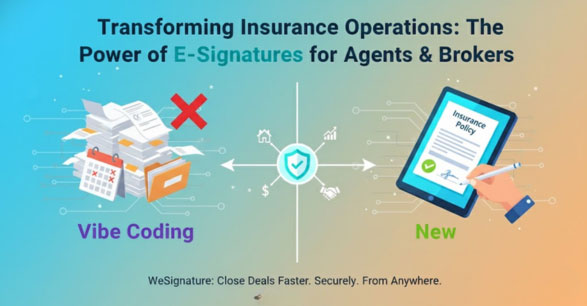
Electronic signatures have been legally recognized for more than two decades, yet many insurance firms still rely on slow, paper-based workflows. The global pandemic accelerated digital adoption across every industry, pushing insurers to rethink how they sell policies, serve clients, and settle claims.
This article focuses on the importance of electronic signatures for agents and brokers, how they function, and what security measures must be taken with respect to insurance documents.
The Legal Basis: ESIGN, UETA, and HIPAA
Insurers must feel confident that the technology being used is legally executable. In order to assure this legal validity for the United States, the Electronic Signatures in Global and National Commerce (ESIGN) Act and the Uniform Electronic Transactions Act (UETA) have been created to ensure this legal verification.
ESIGN, passed in 2000, grants electronic signatures the same legal status as handwritten ones across all 50 states and ensures that a contract or record cannot be denied legal effect simply because it is in electronic form. UETA, adopted by 49 states, lays out a legal framework for using electronic records and signatures in business and government.
Together, they mean policies, endorsements, and claims forms signed electronically are just as binding as ink-on-paper when the solution meets the statutes’ requirements.
Regulated industries such as healthcare and insurance have an additional layer of compliance. The Health Insurance Portability and Accountability Act (HIPAA) governs the privacy and security of Protected Health Information (PHI).
HIPAA is technology-neutral, but it requires organizations that handle PHI to implement safeguards around any electronic process. The HIPAA Journal notes that e-signatures can be used under HIPAA provided mechanisms are in place to ensure the authenticity of the signatory and to ensure that any PHI contained in the document is protected from unauthorized access and disclosure.
In practice, this means using strong authentication, encryption, tamper-evident seals, and audit trails. HIPAA also requires a Business Associate Agreement (BAA) with any vendor that handles PHI. As the eSignly guide to HIPAA-compliant e-signatures explains, a vendor must be willing to sign a BAA and implement robust user authentication, data encryption, message integrity, comprehensive audit trails, and access controls. Choosing a partner that meets these pillars is essential for insurance carriers that also process health-related data in disability, health, or long-term care products.
Data Security and Audit Trails: The Cornerstones of Trust
Consumers trust insurers with sensitive personal and financial information. To earn and keep that trust, agents and brokers must ensure that the e-signature platform protects data at every stage. HIPAA-compliant solutions require user authentication methods (email verification, passwords or multi-factor authentication) to verify the signer’s identity and encryption of data both in transit and at rest. Message integrity and tamper-evident seals ensure that no one can alter a signed document after the fact.
Perhaps the most important security feature for insurance is the audit trail. A compliant solution must provide non-repudiation by creating an audit trail that logs every action taken on the document—who viewed it, when they signed, and their IP address.
Audit trails are critical in disputes because they show that the signer intended to agree to the policy or claim settlement. In the insurance context, they also help detect fraud and support regulatory audits. jSign’s insurance-focused platform highlights that documents signed electronically include an audit trail that records the device ID, IP address, browser, latitude, longitude, and timestamp.
The resulting certificate of completion provides legally admissible evidence if a policyholder later questions a signature. For agents and brokers, this audit trail reduces risk and streamlines compliance with state and federal regulations.
Streamlining Policy Issuance and Endorsements
Traditional policy issuance can take weeks: mailing applications back and forth, waiting for signatures, and dealing with incomplete paperwork. An e-signature workflow transforms this process. According to jSign, when insurance professionals use a modern electronic signature platform, they reduce the time spent on paperwork and can finalize transactions quickly.
Instead of thumbing through copies of claims, policies, and appraisals at the desk, agents manage documents digitally—no more piles of paper. The platform automates document workflows so that forms move seamlessly from application to underwriting to delivery, and agents can handle policy applications, endorsements, account maintenance forms, and declarations in one system.
The ability to send documents for signature instantly means policy issuance is no longer tied to in-person meetings or postal delivery. jSign notes that agents can swiftly sign, send, and receive documents from anywhere, while customers sign from their own devices. This flexibility is crucial for independent brokers who serve clients across multiple time zones.
When an applicant needs to add a vehicle to their policy or make changes to their coverage limits, an agent can quickly issue an electronic endorsement form, obtain an insured’s e-signature in minutes, and immediately update the insured’s policy. The speed of the endorsement process results in a shorter period of time in which a client is able to shop for alternate insurance quotes and increases agent retention rates as well as conversion rates.
Accelerating Claims Processing and Settlements
Claims are the “moment of truth” in insurance. Paper-based claims processes require policyholders to print forms, sign them, and mail or scan them back—delays that frustrate clients. E-signatures enable carriers to send claim forms electronically and obtain signatures in minutes.
When clients report a loss, adjusters can push the necessary authorizations or proof-of-loss forms to their mobile device and receive signed documents while the adjuster is still on the call. Digitizing paperwork and signatures allows carriers to speed up the settlement process and allows adjusters to spend their time on the more complex cases, rather than chasing after documents.
Electronic signatures provide the added advantage of greater accuracy. Electronic forms usually come with validation rules to ensure there are no missing fields or invalid data. Agents can prepopulate customer information in electronic forms, making it much less likely that there will be typographical errors. The audit trail and tamper-evident seal protect the integrity of signed claims documents, preventing them from being changed fraudulently after they have been signed. By providing clients with the ability to obtain documents electronically, carriers significantly reduce the risk of having to deal with client complaints about lost documents, which are common when mailing documents.
Enhancing Agent Productivity and Mobility
Modern insurance producers are often on the move. When using conventional methods of signing, agents are required to hold face-to-face meetings or obtain wet signatures. These lead to longer sales cycles and slower renewal cycles. With jSign, agents are able to sign documents from any location, anytime they have access to the internet; thus, agents can send and receive documents remotely using mobile devices.
In addition, clients expect more digital options and want to complete transactions online using their own devices; removing geographical boundaries enables producers to sell and close transactions during non-business hours or when they travel. This helps producers become more productive and increase customer satisfaction.
In addition, e-signatures save agency operational costs as paper, ink and postage expenses build rapidly. Agencies that mail their policy, claim, and renewal notices will save money by using e-signatures and eliminate the overhead expenses associated with printing and mailing hard-copy documents.
Additionally, since many agents can be employed remotely, there will be less need for agencies to maintain large amounts of office space. For organizations pursuing sustainability goals, sending documents electronically reduces paper waste and energy consumption.
Meeting Regulatory Compliance and Audit Requirements
Insurance is a heavily regulated industry. Producers must comply with state insurance laws, anti-money-laundering regulations, and consumer protection statutes. E-signature platforms designed for insurance incorporate controls to satisfy these obligations.
For example, jSign emphasizes that its platform meets security, audit trail, and legal requirements to process forms, policies, claims, applications, declarations, and insurance certificates. Audit trails and certificates of completion provide evidence that a signer consented to the document and that the process met regulatory standards. Some solutions also allow agents to set signing location restrictions to ensure documents are signed within appropriate jurisdictions, which is helpful for multi-state compliance.
Carriers offering health-related products or handling medical information must meet HIPAA requirements as well. The HIPAA Journal reminds us that e-signatures are acceptable under HIPAA, provided the authenticity of the signatory is ensured and PHI is protected from unauthorized access or disclosure.
Use Cases Across the Insurance Lifecycle
Electronic signatures can streamline nearly every document-centric workflow in insurance. Examples include:
- Sales and New Business. Agents can use e-signatures for proposals, quotations and applications. jSign lists policy applications and proposals among the common use cases for its platform. Applicants review and sign from their mobile device without waiting for a physical meeting.
- Onboarding and Account Maintenance. New agents and clients can complete onboarding packets, licensing forms, and account updates digitally. Electronic signatures also facilitate cross-sell or upsell opportunities, since clients can add coverage with a single click.
- Policy Endorsements and Renewals. Endorsement forms, declarations, and renewals can be sent electronically. Agents receive notifications when clients sign, so there is no need to chase paper.
- Claims Handling. Loss notices, proof-of-loss forms, subrogation agreements, and settlement releases can be executed with e-signatures. Audit trails help defend against fraudulent claims by recording signer identity and timestamps.
- Broker–Carrier Agreements and Compliance Documents. Business Associate Agreements, producer appointments, and non-disclosure agreements can be executed securely and quickly. Comprehensive audit trails demonstrate compliance with regulatory requirements.
Deciding Which Electronic Signature Service Is Right for Insurance
Although there are many electronic signature services available, not every service is right for your business. To determine what service is best for your needs, consider the following factors before deciding on a service:
- Security Certifications and Compliance – It is vital to ensure that the provider you select meets or surpasses the standards set by the industry. These include ISO 27001, SOC 2, and HIPAA, depending on whether your business uses them. Additionally, confirm if the vendor will sign a Business Associate Agreement (BAA) and follow the ESIGN Act, UETA, and, for international providers, the EU eIDAS Regulations.
- Support for strong authentication – The best platforms have multi-factor authentication (MFA) options using email, SMS, and/or biometric verification methods. Additionally, some platforms have resources available for KBA or Knowledge-Based Authentication, which may be necessary for high-risk transactions.
- Audit Trails Provide Complete Records of Transaction History – An audit log should provide specific and complete information about the signer; this includes individual names, signer numbers, IP addresses, geographic locations, timestamps, and event history to support resolving disputes and proving compliance with USA E-Sign regulations. A certificate of completion should be downloadable for record-keeping purposes.
- Easy to Use – If a service has too many features or a steep learning curve, it can hinder its acceptance. As an example, jSign reports that a modern e-signature solution will allow agents and clients to sign and send documents from any mobile, tablet, or desktop computer. It is also essential for providers of e-signature services to integrate with your existing CRM and Policy Administration software solutions to eliminate potential friction when using them.
- Branding and Customization – There are many agencies that operate under their own branding or are associated with the underwriter’s branding. Being able to customize the branding is essential for an agency and underwriters to create a more personal connection between the two entities.
E-signature Integration in Telehealth, AI, and Remote Work
The digital transformation of insurance is far from over. Telehealth and remote care have increased the need for HIPAA-compliant e-signatures, and similar remote trends are shaping life and health insurance underwriting.
Artificial intelligence (AI) and machine learning are being integrated into claims triage and fraud detection, while robotic process automation (RPA) handles routine tasks. As automation accelerates, e-signature platforms will integrate more deeply with AI-driven decision engines.
For agents and brokers, this means less time spent on administrative tasks and more time on consultative selling.
Embrace Digital Transformation with Confidence
Digital signatures are not simply a convenience; they represent a strategic opportunity to transform existing operations, mitigate risk, and provide superior service to clients. The ESIGN Act and UETA provide a solid foundation of legislative support for the use of digital signatures, and digital signatures are fully compliant with HIPAA and other industry regulations for insurance companies when appropriate security controls are implemented.
With client expectations for a digital-centric experience, carriers that rely upon traditional paper-based transaction methods run the risk of losing clients to more agile competitors. Now is the ideal time for all insurance agents, whether independent or larger brokerage firms, to implement an “e-signature for insurance” business model. By choosing a digital signature solution that incorporates adequate security and compliance features, your agency will be able to modernize operations, enhance productivity, and ultimately provide superior service to your clients.
Beyond operational improvements, digital signatures can help insurers meet sustainability targets by reducing paper consumption and energy use and cutting resource waste. Electronic workflows will soon be the norm rather than the exception in insurance. Adopting these tools now prepares agencies for a digital-first marketplace and beyond.
