
Beyond the Classroom: E-Signatures for Education Administration & Student Services
Digital transformation is reshaping how schools and universities operate. Paper-based processes slow down enrolment, delay communications, and expose student data to unnecessary risk.
Digital transformation in education no longer ends at online classes and learning platforms. Today, institutions are looking for smarter ways to manage the administrative side of student life — from admissions to financial aid to campus services. One of the most impactful tools leading this shift is the e-signature.
As education becomes increasingly hybrid, administrators, faculty, and students all need faster, more reliable ways to handle approvals and documentation. E-signatures also make it easier for a document signer to review, approve, and submit forms from any device, eliminating the delays that come with paper-based workflows.
E-signatures offer a secure, compliant, and efficient solution that takes daily processes “beyond the classroom” and into a fully modernized student lifecycle. E-signature for education solutions (also called document signer platforms) have moved from “nice to have” to essential.
The Rapid Growth of E-Signature Adoption
Industry reports show just how quickly e-signatures are replacing paper workflows:
- Market value and growth: Data from 2025 show that the global digital signature market is valued at US $12.22 billion and is expected to reach US $238.42 billion by 2034, a compound annual growth rate of about 39 %. North America accounts for roughly 46 % of global revenue.
- Widespread adoption: Surveys indicate that 60 – 80 % of organizations across industries already use some form of e-signature technology, although 20 – 40 % still rely on paper signatures. Over 95 % of businesses are either using or plan to use e-signatures.
- Efficiency gains: Businesses report savings of US$4 – US$10 per document on printing, scanning and postage costs and up to US$28 per signed document overall. Contract processing times drop by 28 – 80 %, with 79 % of agreements signed within 24 hours, and employees save approximately 300 labour hours per month through e-signature automation.
- The Use of Mobile and Cloud: 70% of e-signature use occurs on mobile devices, while 90% of companies prefer using cloud-based systems for the simplicity of deployment and maintenance.
- Environmental Impact: Upwards of 80% of the amount of paper being consumed will be eliminated when transitioning to e-signatures, replacing an estimated average of 20,000 pieces of paper per year for each 100 employees and eliminating enough carbon emissions to equal five less cars on the road. The annual savings for companies that utilize e-signatures equate to approximately $80, or £50, per employee through reduced paper, printing and storage and up to 15%-25% reduction in their carbon footprint.
These statistics highlight why digital workflows are on the rise by 2026. For the educational industry, digital workflows provide additional savings beyond financial benefits and increase student privacy, parental engagement, and compliance with strict data protection requirements.
Why Educational Institutions Need E-Signatures
1. Accelerated enrolment and admissions
Paper enrolment packets are slow to complete and easy to lose. Electronic signatures allow institutions to accept applications, consent forms and enrolment agreements digitally, enabling students and guardians to sign from any location. Schools can deliver acceptance letters and contract offers instantly, speeding up decision-making.
2. Parental Consent and Student Services
Educators have many occasions when they need to obtain a signature from a parent/guardian. Examples include obtaining permission for a field trip, athletics, a special education plan, or a medical release. Parents can now review and sign consent forms for remote learning at their convenience. Digital systems automatically notify parents of pending signatures and track completion, eliminating the risk that parents will misplace their child’s permission slips.
3. Simplified administration and HR
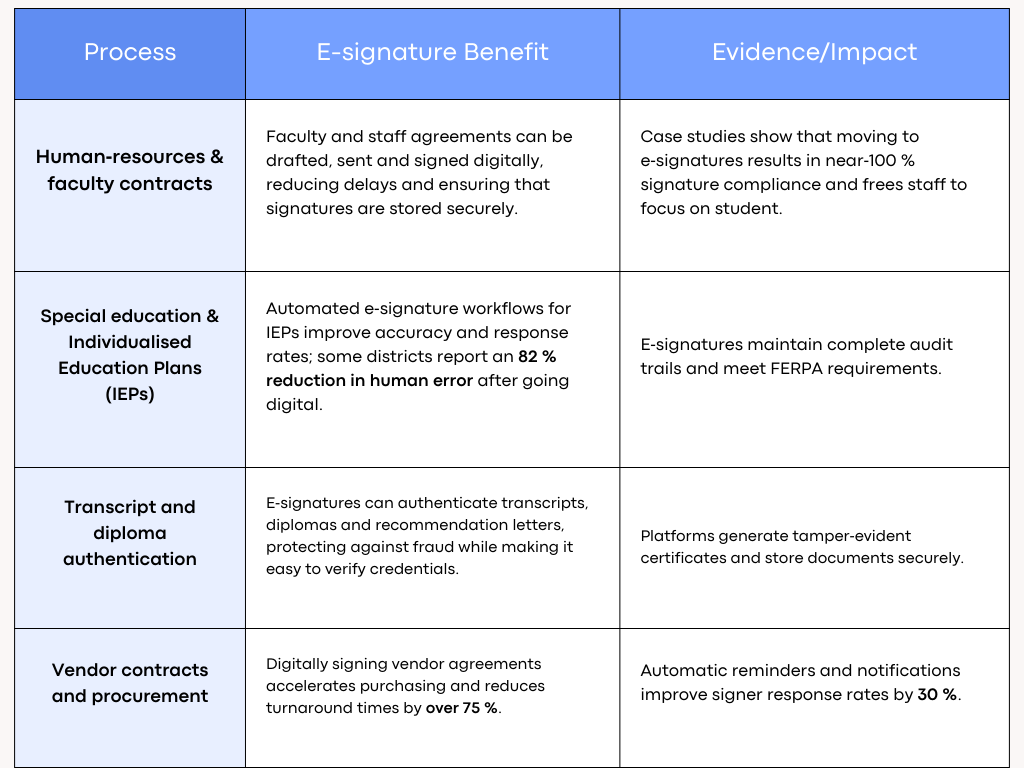
E-signatures streamline hundreds of back-office tasks:
4. Supporting Distance Learning and Remote Learning
Obtaining physical signatures for the purposes of collecting attendance, assignments, and exam signatures can be difficult during remote learning (i.e., online learning or distance learning) environments. However, e-signatures allow educators to collect these records online, thus allowing students who are learning at a distance to have the same access to administrative processes as students who are physically present in the classroom or school. Digital forms will improve access for students with disabilities, students in rural areas, and ultimately help close the equity gap.
5. Enhancing Compliance with FERPA and Data Privacy
Every student’s privacy is a top priority. The Family Educational Rights and Privacy Act (FERPA) allows schools to accept “signed and dated written consent” electronically, if specific criteria are met. FERPA-compliant e-signature systems must:
- Verify the identity of the signer by means, i.e., PIN, password, biometric fingerprint reader, or knowledge-based questions.
- Capture clear evidence of intent, meaning the signer must take a deliberate action (e.g., clicking a “Sign” button), and the consent language must be clear.
- Maintain auditable records — a verifiable audit trail must record who signed, when, and from which IP address, and documents must be protected against alteration.
Common educational uses include releasing student records, collecting parental permissions for minors, processing enrolment forms, financial-aid documents, accommodations requests, and FERPA waivers. Schools should select a solution with robust authentication, develop clear policies, establish record-retention procedures, and train staff on proper handling of electronically signed documents.
6. Student privacy and societal trends
Concerns about children’s safety online are driving stricter regulations worldwide. In November 2024, Australia enacted one of the world’s toughest social-media laws: from 9 December 2025, platforms like Facebook, TikTok, Snapchat, and YouTube must block users under 16; non-compliant companies may be fined up to A$49.5 million.
Although targeted at social media, this law highlights a broader push to safeguard minors’ digital identities. The advancement of educational institutions will occur as they implement e-signature tools focused on improving parental control and ensuring the security of student-specific data.
Technological advances and innovative developments are driving the evolution of the e-signature industry. They include:
- Integration of APIs: These reduce data entry errors by 60%, as approximately 72 percent of companies use e-signatures in their processes.
- Quantum-Resistant Signatures and Blockchain: Approximately 35 percent of companies have invested in blockchain and quantum-resistant signature technology. This will be collected and analyzed for further debugging by the other 10 percent of the vendors.
- Artificial Intelligence: Around 40% of the best companies have implemented Artificial Intelligence for the purposes of control over fraud, biometric verification of users, and enhancing the user experience.
- Mobile and cloud technology: It is estimated that more than 70% of the e-signatures are done using mobile devices, and in 2022, there has been a 50% increase in the adoption of cloud-based solutions, which has made life easier for students and faculty members while doing secure signing from anywhere in the world.
Mitigating Risks and Other Challenges
Though the trend of increasing adoption may be valid, there still remain issues that need to be tackled, and these include:
- The digital divide: It has been estimated that globally, between 20 and 40 percent of institutions still use paper and pen to sign documents. In schools, the issues compound the lack of reliable internet connections or training. Such institutions should look into providing other convenient options for the families that are not able to connect to the internet.
- Security concerns: This affects about 17 percent of organizations and pushes them away from e-signing up, saying that they are concerned about security. However, this is not the largest benefit for approximately 83% of users. It is wise to utilize a vendor who provides end-to-end encryption of data, multi-layer authentication and auditable logs that can help reduce risk.
- Cyber threats: Cyber attacks on software have been shown to account for 61% of all cyber threats. Vendors should ensure compliance with internationally recognized protocols like SOC 2, ISO 27001, while access is being monitored by schools.
- Regulatory complexity: It has been established that over 15% of organizations are postponing the implementation because of the regulations in place. One potential remedy for this is to consult an attorney and use vendors that are experienced with FERPA, COPPA and GDPR laws.
Environmental, Cost and Productivity Impact
Adopting e-signatures delivers measurable sustainability benefits:
- Businesses cut paper use by up to 80 %, saving 20,000 sheets per 100 employees and reducing waste by 60 %. Electronic workflows also reduce storage space by 90 %.
- Paper document processing costs US $6 – 8 per document; e-signature processing costs only US $0.50 – 1.00. Transitioning can save up to US $80 per employee annually.
- Companies report a 50 % increase in productivity related to document management and 44 % improved employee satisfaction because manual paperwork is eliminated.
Conclusion
As we move beyond the classroom and into an increasingly digital 2026, e-signatures for education platforms are more than a convenience — they are a foundational component of modern administration. By digitizing enrolment, permission slips, HR contracts and student services, schools can save money, reduce environmental impact and improve experiences for students and parents. Crucially, e-signatures support FERPA compliance through strong authentication, clear intent and secure record-keeping.
The trend toward heightened child-safety regulations — exemplified by Australia’s social-media ban for under-16s — signals that privacy and consent will only become more important. Education leaders who adopt secure document signer solutions now will be better positioned to protect student data, engage parents and operate efficiently in the digital era.
