E-Signature Trends in 2026: What U.S. Businesses Need to Know
Key Takeaways
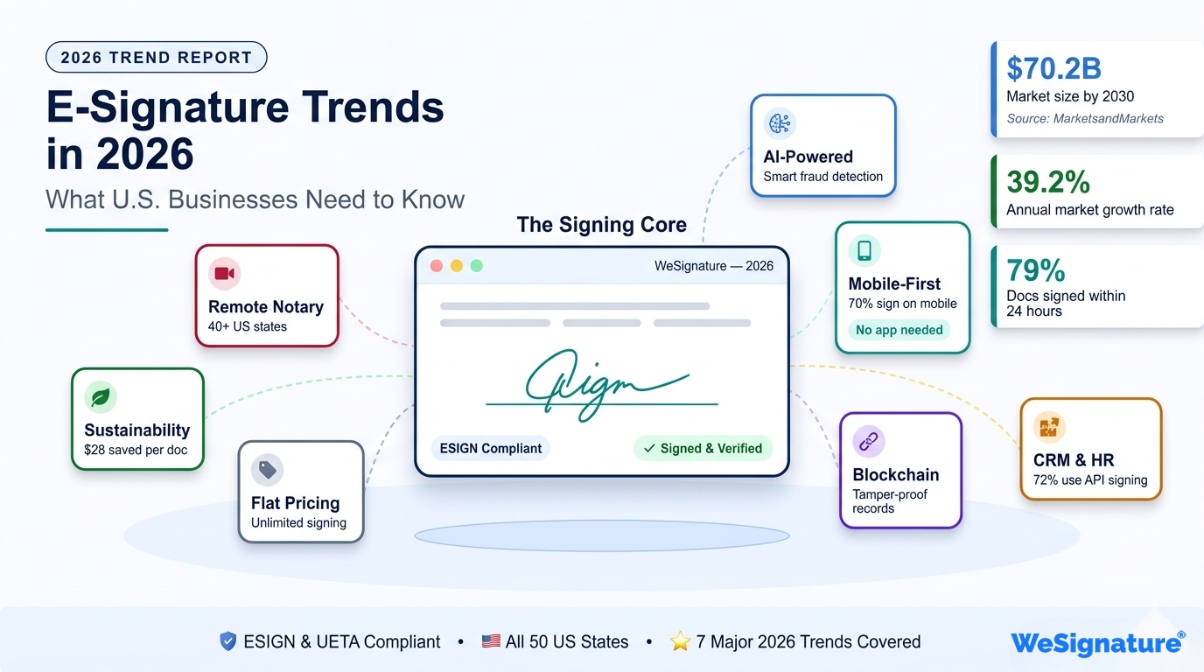
- The global digital signature market is projected to grow from $13.4 billion in 2025 to $70.2 billion by 2030, at a 39.2% CAGR (MarketsandMarkets).
- AI is now used by 40% of leading e-signature providers for fraud detection, identity verification, and workflow automation.
- 78% of US law firms have adopted e-signature software, and 65% of real estate transactions now use digital signing.
- Around 70% of E-signatures are completed on mobile devices, making mobile-first design a non-negotiable platform feature.
- 90% of enterprises prefer cloud-hosted E-signature platforms, with cloud solutions seeing a 50% adoption increase since 2022.
- Remote Online Notarization (RON) is expanding state by state in 2026, bringing legally compliant remote notarization into mainstream workflows.
- Businesses save an average of $28 per signed document and up to 300 labor hours per month by switching from paper to digital signing.
The biggest e-signature trends in 2026 are AI-powered contract intelligence, mobile-first signing, blockchain verification, deeper CRM and HR integrations, remote online notarization, sustainability reporting, and more flexible pricing models. For U.S. businesses, these trends are changing e-signatures from a simple signing tool into a core workflow, compliance, and revenue operations system.
The E-signature trends in 2026 are no longer optional reading for US businesses. They are the roadmap for how contracts get closed, how compliance gets met, and how operations stay competitive. What started as a convenience during the pandemic years has matured into core business infrastructure, and the shift is accelerating faster than most teams have budgeted for.
If your business is still treating digital signing as a line item rather than a strategic lever, this guide is for you. Whether you are in legal, real estate, insurance, HR, or running a small business, understanding the biggest digital signature trends in 2026 is critical for staying ahead of your competitors and your clients’ expectations.
In this guide, we break down every major e-signature trend reshaping the US market right now, backed by real data, and show you what each trend means practically for your business workflows.
This guide was compiled using publicly available e-signature market reports, vendor product documentation, pricing pages, and U.S. electronic signature compliance resources. Vendor pricing and feature availability were reviewed as of [Month Year] and may change.
The E-Signature Market in 2026: Size, Growth, and U.S. Business Impact
Before diving into specific trends, the market context sets the stakes. According to MarketsandMarkets, the global digital signature market is projected to grow from $13.4 billion in 2025 to $70.2 billion by 2030, a compound annual growth rate of 39.2%.
North America holds the dominant regional share at 38%, driven by the legal infrastructure of the ESIGN Act and UETA, which give electronic signatures the same legal weight as handwritten ones across all 50 states.
That growth is not a coincidence. Businesses that have shifted to digital signing report saving an average of $28 per signed document compared to paper processes, cutting contract processing time by as much as 80%, and signing 79% of agreements within 24 hours. The economics are simply too strong to ignore.
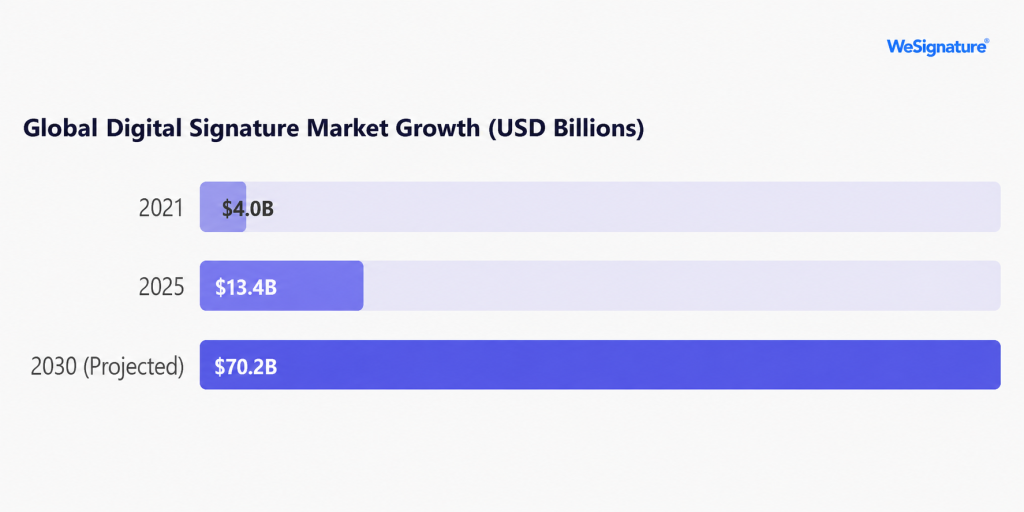
Source: MarketsandMarkets, Digital Signature Market Report, 2025. Figures represent global market size projections at a 39.2% CAGR.
Top E-Signature Trends in 2026 for U.S. Businesses
1. AI-Powered E-Signature Software Is Becoming Standard
Artificial intelligence is the biggest disruptor in the eSignature space right now. As of 2026, 40% of leading eSignature providers have integrated AI for fraud detection, identity verification, and user experience improvements.
The practical impact is significant: AI reduces document processing times by up to 50% in enterprise settings by automatically flagging missing fields, identifying high-risk clauses, and routing documents to the correct signers without manual intervention.
For US businesses, this means the signing platform itself becomes a decision support tool. Instead of simply capturing a signature, AI-enabled platforms analyze contract patterns, surface potential compliance issues, and predict turnaround times.
Legal, HR, and sales teams are the biggest immediate beneficiaries. Platforms like DocuSign and Adobe Sign have moved aggressively on AI contract analytics, which is a key area where newer platforms need to either match functionality or compete on price and simplicity.
2. Mobile E-Signatures Are Now the Default Signing Experience
Around 70% of eSignatures are now completed on mobile devices, particularly in finance and real estate. This is not a marginal shift. It means any eSignature platform that has not invested in responsive design, tap-to-sign interfaces, and SMS-based document delivery is already behind the curve.
Cloud-based e-signature solutions have seen a 50% increase in adoption since 2022, and 90% of enterprises actively prefer cloud-hosted platforms over on-premise alternatives.
For US SMBs, mobile-first signing directly affects close rates. A client who has to switch devices or download an app to sign a contract is likely to abandon the process. Features like email-to-sign and text-to-sign links, which let recipients open and sign on any mobile browser without an account, have become table-stakes expectations rather than premium differentiators.
3. Blockchain Verification Is Moving From Pilot to Production
Blockchain-based eSignature adoption has grown 35% year over year, according to Certinal’s e-signature statistics. The technology creates an immutable, timestamped record of every signature event stored in a distributed ledger.
For industries like financial services, healthcare, and legal, where document integrity is critical, blockchain verification transforms audit trails from a compliance checkbox into a litigation-proof record.
Patent filings related to blockchain audit trails and biometrics climbed 210% between 2024 and 2025, signaling that this is not a future feature but an active development priority across the industry. US businesses in regulated sectors should be asking their eSignature vendors directly what their blockchain roadmap looks like.
4. CRM, HR, and ERP Integrations Are Replacing Standalone Signing Tools
The era of sending someone to a separate signing platform is fading. In 2026, 72% of organizations use eSignature APIs to integrate digital signing directly into their existing workflows, and 63% of Salesforce users activate signature connectors within 30 days of deployment. Microsoft’s addition of native signing to Word, Outlook, and SharePoint in late 2024 captured 18% of mid-market share in North America within nine months of release.
The message for US businesses is clear: your signing workflow should live inside your CRM, your HRIS, your project management tool, or wherever the document originates. Manual switching between apps creates friction, slows deals, and introduces errors.
Workflow automation through e-signature platforms already delivers a 45% improvement in contract lifecycle management efficiency and a 30% reduction in turnaround times through automated reminders alone. You can read more about how to modernize these workflows in our guide on contract management.
5. Remote Online Notarization (RON) Is Expanding Across the U.S.
Remote Online Notarization allows signers and notaries to complete the notarization process entirely online through audio-video technology, identity verification, and a digital seal. As of 2026, more than 40 US states have passed RON legislation, and that number continues to grow.
Industries with notarization requirements, including real estate closings, estate planning, loan documents, and certain court filings, are seeing RON become the expected default in markets where it is legally approved.
For real estate professionals and legal teams, RON can reduce closing times from days to hours. E-Signature platforms that offer built-in RON workflows, or clean integrations with RON providers, will command a pricing and efficiency advantage as legislation continues to expand.
This is a trend with compounding value: every state that passes RON legislation adds a new addressable use case for your digital signing setup.
6. Sustainability Metrics Are Becoming Part of E-Signature ROI
ESG reporting requirements and corporate sustainability goals are bringing a new dimension to e-signature platform conversations. Every digital signature eliminates paper, printing, ink, and shipping from a document’s lifecycle.
Businesses going paperless cut costs related to physical document handling by 80% to 97% per employee annually. As sustainability audits become part of vendor evaluation and stakeholder reporting, e-signature platforms that can quantify environmental savings, paper eliminated, carbon offsets, and printing costs avoided will have a measurable advantage in enterprise procurement conversations.
7. Predictable Pricing and Unlimited Signing Are Becoming More Important
As e-signature usage grows, U.S. businesses are paying closer attention to how pricing scales with document volume. Per-envelope and usage-based pricing can become expensive for teams that send a high number of contracts, onboarding forms, proposals, or vendor agreements each month.
In 2026, predictable pricing is becoming an important buying factor, especially for small and mid-sized businesses. Platforms like WeSignature that offer flat-rate or unlimited signing models can help companies control costs as their document workflows grow.
E-signature Performance Data: Key Metrics for US Businesses in 2026
The table below summarizes the most relevant e-signature impact metrics drawn from published industry research.
| Metric | Measured Outcome |
| Average savings per document | $28 saved per signed document compared with paper-based processing |
| Agreements signed within 24 hours | 79% of documents were signed the same day |
| Contract processing time reduction | 28%–80% faster, depending on workflow |
| Employee hours saved per month | Approximately 300 labor hours saved per month |
| Enterprise cloud platform preference | 90% prefer cloud-hosted platforms over on-premise solutions |
| AI adoption among top eSign providers | 40% of leading platforms use AI for fraud prevention and identity verification |
| Blockchain e-signature adoption growth | 35% year-over-year increase in adoption |
Table Description: e-signature performance benchmarks for US businesses. Data compiled from Certinal (2025) and Verdocs (2026) published industry statistics.
E-signature Adoption by Industry in the US (2026)
Adoption rates vary significantly by sector. Legal services and financial services lead, while healthcare is the fastest-growing vertical with approximately 40% year-over-year growth.
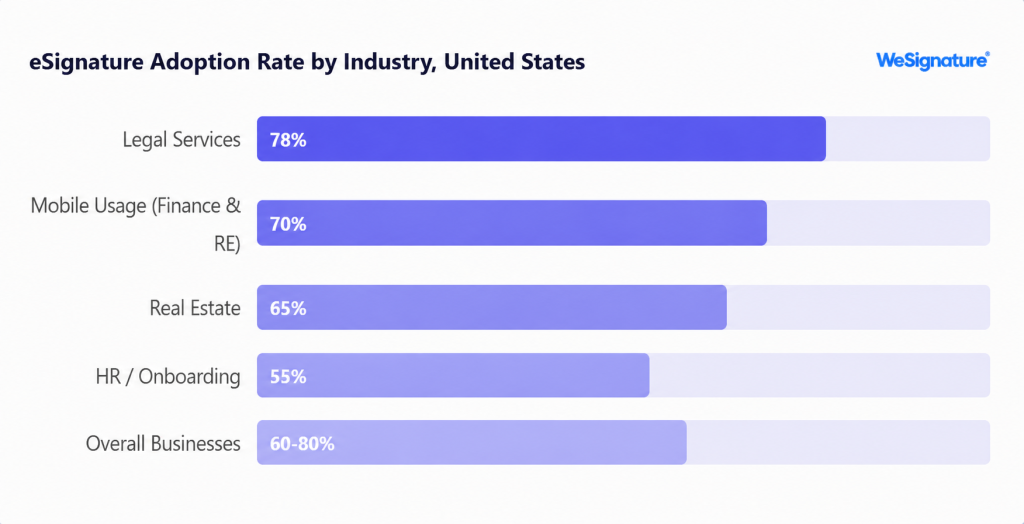
Source: Verdocs E-signature Adoption Statistics (2026) and Certinal eSignature Statistics (2025). Legal Services reflects US law firm adoption; Real Estate reflects the percentage of US property transactions using eSignatures.
How Leading US eSignature Platforms Compare on 2026 Trend Features
Not every platform has kept pace with these trends equally. Below is a side-by-side comparison of key 2026 trend features across the leading US eSignature providers.
| Feature | WeSignature | DocuSign | Adobe Acrobat Sign | PandaDoc | Dropbox Sign |
| Unlimited envelopes | Yes, flat pricing | Varies by plan | Varies by plan | Varies by plan | Varies by plan |
| Mobile-first text signing | Yes | Limited / plan-dependent | Limited / plan-dependent | Not core focus | Not core focus |
| AI-assisted features | In development | Yes | Yes | Yes | Basic/limited |
| CRM integrations | Zapier, API | Salesforce and others | Microsoft 365 and others | CRM-focused | API and integrations |
Table Description: Feature comparison across leading U.S. e-signature platforms based on publicly available product information as of 2026. Pricing reflects entry-level annual billing tiers where available. Feature availability may vary by plan and should be verified directly with each vendor.
How to Choose an E-Signature Platform in 2026
Choosing the right e-signature platform in 2026 is not only about whether a tool can collect a legally valid signature. U.S. businesses should evaluate how well the platform fits their workflow, pricing model, compliance needs, and growth plans.
| Selection Factor | Why It Matters |
| Pricing model | Predictable pricing helps avoid unexpected costs as document volume grows. |
| Mobile signing | Mobile-friendly signing improves completion rates and reduces signer friction. |
| CRM and workflow integrations | Integrations reduce manual work and keep signed documents connected to business systems. |
| Compliance support | ESIGN, UETA, audit trails, and authentication help support legal validity. |
| Signer authentication | Identity verification is important for high-value or regulated agreements. |
| Payment collection | Combining payments and signatures reduces extra steps in sales and service workflows. |
| Scalability | The platform should support higher document volume as the business grows. |
What E-Signature Trends in 2026 Mean Practically for US Small Businesses
For small and mid-sized businesses in the US, the biggest risk is choosing a platform built for 2022 workflows. Per-envelope pricing models were designed for low-volume enterprise users.
In 2026, a growing SMB can easily send hundreds of documents per month, from onboarding contracts to vendor agreements to client proposals. When per-envelope costs stack up, the platform that seemed affordable at signup becomes a drag on growth.
The integration gap is the other major concern. If your e-signature tool does not connect to your CRM, your HR system, or your payment processor, you are adding manual steps to every signed agreement. That manual overhead compounds across your team. Understanding e-signature security and knowing what to look for in a compliant platform is equally important before committing to any vendor long-term.
The businesses winning in 2026 are the ones that treat their signing tool as part of their operating infrastructure, not as a standalone utility. They track completion rates, automate follow-up reminders, route documents by role, and connect signing events to downstream actions in their stack.
Worth noting: If you are evaluating platforms, WeSignature’s flat-rate unlimited signing model means your cost does not scale with your volume. That is a structural advantage for any business that expects to grow its document throughput. You can also explore how to pick the right tool in our full best software 2026 comparison guide.
E-Signature Trends Checklist for Choosing a Platform in 2026
Before choosing an e-signature platform in 2026, U.S. businesses should check whether it offers:
- Mobile signing without app downloads: Signers should be able to open, review, and sign documents from any device without extra friction.
- CRM, HR, and payment integrations: The platform should connect with the tools your team already uses so signed documents flow into existing workflows.
- Complete audit trails: Every document should include a record of when it was sent, viewed, signed, and completed.
- Predictable pricing: Pricing should scale clearly with your document volume, especially if your team sends a high number of agreements each month.
- Signer authentication: For high-value or regulated documents, look for verification options such as email verification, multi-factor authentication, or ID checks.
- Payments with e-signatures: If your workflow involves invoices, deposits, or service agreements, collecting payment during signing can reduce extra steps.
- ESIGN and UETA compliance: The platform should support legally valid electronic signatures for most U.S. business agreements.
Compliance and Legal Validity: What Stays the Same in 2026
While technology evolves rapidly, the legal foundation in the US remains stable. The ESIGN Act and UETA continue to give electronic signatures full legal equivalence to handwritten signatures across all 50 states. For regulated industries, HIPAA compliance, SOC 2 certification, and detailed audit trails are still the baseline requirements for any eSignature vendor evaluation.
If you are in legal services, reading a dedicated resource like the legal professionals’ guide is a good place to understand jurisdiction-specific requirements beyond standard compliance.
The compliance landscape is evolving in one specific direction: identity verification is getting stricter. Multi-factor authentication, biometric identity checks, and government-issued ID verification are becoming expected features rather than upgrades. Businesses handling high-value contracts or operating in regulated industries should prioritize platforms that offer tiered authentication options.
E-Signature Trends in 2026 Are Not Optional
The e-signature trends in 2026 point to one unmistakable direction: digital signing is no longer just about replacing paper. It is about building faster, more intelligent, and more integrated business workflows. AI is automating document intelligence.
Mobile is the primary signing surface. Blockchain is hardening security. Integrations are eliminating workflow gaps. RON is removing geographic barriers to notarization. And sustainability metrics are making the business case even stronger.
For teams with growing document volume, the best e-signature platform is not always the one with the longest feature list. It is the one that combines predictable pricing, mobile-friendly signing, workflow integrations, compliance support, and a simple signing experience.
WeSignature is built around these priorities, with flat-rate pricing, mobile-friendly signing, combined payments and signatures, and a compliance framework aligned with U.S. legal standards. If your current signing process feels expensive, slow, or disconnected from the rest of your workflow, it may be time to evaluate a more scalable option.
FAQs
What are the biggest e-signature trends in 2026?
The biggest e-signature trends in 2026 are AI-powered document intelligence, mobile-first signing experiences, blockchain-based verification, deep CRM and workflow integrations, and the rapid expansion of Remote Online Notarization (RON) across US states. Collectively, these trends are shifting eSignatures from standalone tools into core operational infrastructure for US businesses.
How big is the e-signature market in 2026?
The global digital signature market is valued at approximately $13.4 billion in 2025 and is projected to reach $70.2 billion by 2030, growing at a CAGR of 39.2% according to MarketsandMarkets. North America holds the dominant regional share at around 38%, driven by the legal frameworks of the ESIGN Act and UETA that provide full legal validity for electronic signatures across all 50 US states.
Is AI being used in e-signature platforms in 2026?
Yes. As of 2026, 40% of leading e-signature providers use AI for fraud detection, identity verification, and workflow automation. AI integration reduces document processing times by up to 50% in enterprise settings and enables features like automatic clause flagging, smart routing, and risk analysis, turning the signing platform into an active document management tool rather than a passive signing interface.
What percentage of e-signatures are completed on mobile devices in 2026?
Around 70% of e-signatures are now completed on mobile devices, particularly in finance and real estate. This reflects the broader shift toward remote work, on-the-go workflows, and the expectation that signers can review and execute documents from any device without needing to download an app or access a desktop computer.
Is Remote Online Notarization (RON) legally valid in the US in 2026?
Yes, Remote Online Notarization is legally valid in over 40 US states as of 2026, with more states actively passing or updating RON legislation. RON allows a notary public and a signer to complete the notarization process entirely online through video conferencing and digital identity verification, making it legally binding for real estate closings, estate documents, loan signings, and other notarized transactions in states where it is approved.
What should U.S. businesses look for in an e-signature platform in 2026?
U.S. businesses should look for mobile signing, predictable pricing, CRM or HR integrations, complete audit trails, signer authentication, ESIGN and UETA compliance, and the ability to scale with document volume.
Are unlimited e-signature plans better than per-envelope pricing?
Unlimited e-signature plans can be better for businesses that send a high volume of documents each month. They make costs more predictable and reduce the risk of paying more as signing volume grows.
Can e-signature platforms collect payments?
Some e-signature platforms support payment collection directly inside the signing workflow, while others require a separate payment tool or integration. For sales, service, and SMB workflows, combining payments and signatures can reduce friction.
Is DocuSign the only option for business e-signatures?
No. DocuSign is one of the most established e-signature platforms, but businesses can also consider alternatives such as Adobe Acrobat Sign, PandaDoc, Dropbox Sign, and WeSignature, depending on their pricing, integration, mobile signing, and workflow needs.