
7 Digital Contract Management Best Practices to Reduce Risk and Speed Up Contracts
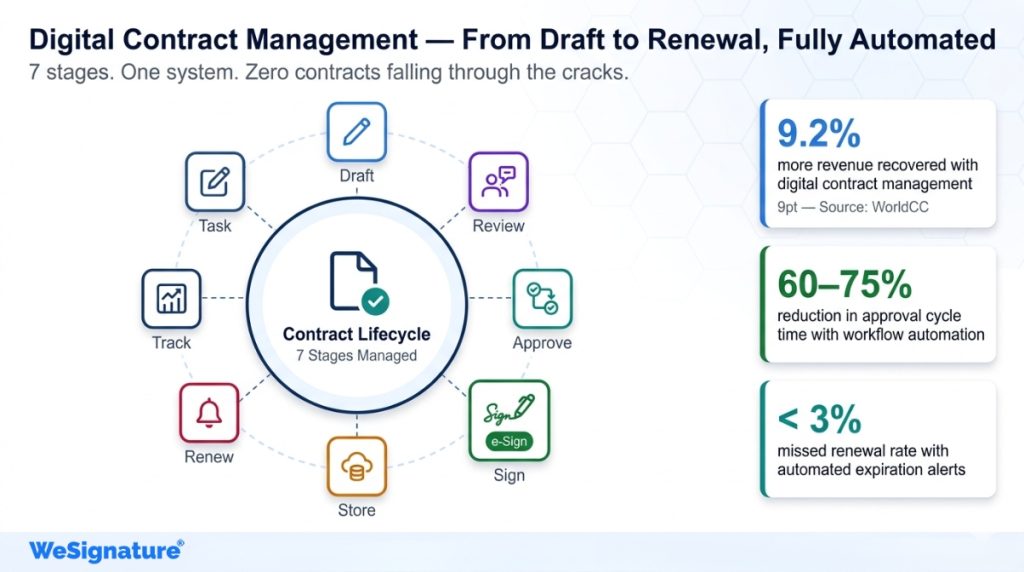
Key Takeaways
- Digital contract management reduces average contract cycle times from weeks to days by replacing manual handoffs with automated workflows.
- Businesses that lack a centralized contract repository lose an average of 9.2% of annual revenue to poor contract performance, according to WorldCC research.
- Standardizing templates and approval workflows eliminates the version-control errors that cause disputes and delays in manual contract processes.
- Legally binding electronic signatures are the fastest way to close the final execution gap in any contract lifecycle, and are fully enforceable under ESIGN and UETA in all 50 US states.
- Automated renewal alerts prevent costly contract rollovers and missed termination windows that go unnoticed in spreadsheet-based tracking systems.
- A complete audit trail is non-negotiable for regulatory compliance: it logs every view, edit, and signature with timestamps and IP addresses.
- Tracking KPIs such as cycle time, renewal rate, and compliance score turns your contract portfolio from a liability into a strategic business asset.
Digital contract management helps businesses create, approve, sign, store, and track contracts in one secure system instead of relying on email threads, shared drives, spreadsheets, and paper files.
For many growing teams, the goal is not to buy complex enterprise software. It is to find practical contract management software for small businesses that makes everyday agreements easier to draft, approve, sign, store, and retrieve.
Digital contract management fixes that problem by bringing the entire contract lifecycle, from drafting and negotiation through execution and renewal, into a structured, searchable, and automated system.
This guide covers the proven best practices that legal, operations, and sales teams across the US are using to cut contract cycle times, reduce compliance risk, and eliminate the costly mistakes that come with manual processes.
Whether you are just moving off paper or ready to upgrade a tool that no longer fits your workflow, these practices apply directly to where your contracts are breaking down right now.
This guide is built for small and mid-sized US businesses that manage contracts across sales, operations, HR, finance, legal, or vendor management. It is especially useful for teams that need faster approvals, legally binding e-signatures, centralized storage, renewal reminders, and a reliable audit trail without adopting a complex enterprise CLM system.
What Is Digital Contract Management and Why It Matters
Digital contract management software helps businesses manage contracts through every stage of the agreement process, including drafting, review, approval, e-signature workflow, storage, renewal tracking, and compliance documentation.
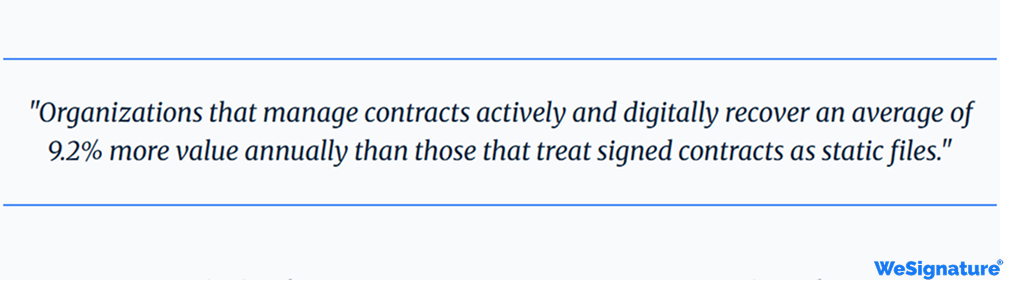
According to WorldCC research, the world’s leading authority on commercial contract practices, organizations that actively manage contract performance recover an average of 9.2% more value from their contracts than those that treat them as static documents. In concrete terms, a $10M annual contract portfolio managed digitally is worth approximately $920,000 more per year than the same portfolio managed through shared drives and spreadsheets. That gap comes from three sources: faster execution that captures revenue earlier, fewer disputes from ambiguous or outdated terms, and timely renewals that prevent lapsed agreements from creating liability gaps.
US Legal Context: Electronic contracts and signatures are fully enforceable under the federal Electronic Signatures in Global and National Commerce Act (ESIGN) and the Uniform Electronic Transactions Act (UETA), which has been adopted in 49 states. Digital contract management systems that include audit trails and tamper-evident storage meet evidentiary standards for US courts. For a deeper look at legally bindingrequirements for electronic signatures, WeSignature’s compliance guide covers the full regulatory landscape.
The Contract Lifecycle: Stages Every Team Needs to Manage
Before applying best practices, your team needs a shared vocabulary for the stages a contract moves through. Many contract failures happen because one stage is handled well, and the next is handled by a different team with no handoff system.
The lifecycle typically includes initiation (identifying the need and requesting a contract), drafting (creating the document from a template or from scratch), negotiation and redlining (exchanging edits and reaching agreement on terms), approval (internal sign-offs from legal, finance, and management), execution (collecting signatures from all parties), obligation management (tracking deliverables, payment terms, and milestones), and renewal or termination (renewing, renegotiating, or ending the agreement at expiration).
This broader process is often called contract lifecycle management, or CLM. However, not every business needs a complex enterprise CLM platform. Many SMBs only need the core lifecycle features: templates, approvals, e-signatures, centralized storage, renewal alerts, and audit trails.
Digital contract management software maps workflows to each of these stages so nothing falls through the cracks between them. Before you choose a tool or redesign your process, mapping which stages currently break down in your organization is the most important diagnostic step.
Most teams find the bottlenecks cluster around approvals and execution, which is why workflow automation and e-signatures deliver the fastest measurable ROI.
7 Best Practices for Digital Contract Management That Actually Move the Needle
1. Build a Centralized Contract Repository
A contract repository is the central source of truth for signed agreements, drafts, metadata, renewal dates, and owner details and for searching them. Every contract your organization has ever signed should live in one searchable location with consistent metadata: party names, contract type, effective date, expiration date, and owner. Contracts scattered across individual inboxes and departmental drives cannot be reliably tracked, audited, or renewed.
A centralized repository eliminates the “where is the contract?” question and enables your team to surface obligations, expiration dates, and counterparty relationships instantly. Most contract management platforms include repository functionality with tagging and full-text search built in.
2. Standardize Templates for Every Contract Type
Drafting contracts from scratch every time introduces inconsistency, extends cycle times, and creates legal exposure when non-standard language slips through. Building a template library for your most common contract types (NDAs, MSAs, SOWs, offer letters) means your team starts every contract with pre-approved, legally reviewed language.
Pair templates with a short playbook that defines which clauses are fixed and which are negotiable. If you need to write a contract from the ground up before you have templates, WeSignature’s step-by-step guide covers the full structure and key considerations.
3. Automate Approval and Review Workflows
Manual approval chains (forwarding a Word document to three people, waiting for comments, and consolidating redlines by hand) are the single biggest source of contract delays in US businesses.
Digital workflow automation routes contracts to the right reviewers in the right sequence, sends automatic reminders, and escalates to managers when approvals stall. It also eliminates version confusion by maintaining one document with a tracked revision history rather than six email-attached versions.
Setting SLAs for each approval stage (for example, legal review within two business days) and enforcing them through the system cuts average approval time by 60 to 75% in most implementations.
4. Collect Legally Binding Electronic Signatures
Printing, scanning, and emailing contracts for wet-ink signatures adds days to your cycle time and creates a document custody gap that complicates disputes. Legally binding e-signatures close the execution step the same day the contract is ready, regardless of where the counterparty is located.
Under ESIGN and UETA, e-signatures carry the same legal weight as handwritten signatures for virtually all commercial contract types in the US. Platforms like WeSignature include multi-party signing workflows, real-time status notifications, and automatic completion packets delivered to all signers, eliminating the follow-up emails that slow down the contract signing process in manual systems.
5. Set Automated Renewal and Expiration Alerts
Auto-renewal clauses in vendor contracts cost US businesses hundreds of millions of dollars annually because no one was tracking the opt-out window. Expiration tracking in a digital system sends alerts at 90, 60, and 30 days before key contract dates, giving your team time to renegotiate, terminate, or renew on intentional terms rather than default rollover terms. This is especially critical for multi-year agreements with evergreen renewal clauses common in SaaS, real estate, and service contracts.
6. Maintain a Complete Compliance Audit Trail
Every contract action (viewing, editing, sending, signing) should generate a timestamped log entry tied to a specific user and device. This audit trail is your evidentiary record in a dispute, your documentation in a regulatory audit, and your internal accountability system.
Platforms with strong audit trail functionality log IP addresses, geolocation data, and authentication methods for each signature event. For regulated industries such as insurance, healthcare, and real estate, this level of signature security documentation is not optional. It is a compliance requirement.
7. Track Contract Performance with KPIs
Contracts that are signed and filed but never reviewed again represent unrealized value. Key performance indicators like average contract cycle time, on-time renewal rate, contract compliance score, and average revenue per contract type give your team actionable intelligence to optimize the process continuously.
Contract analytics built into modern CLM platforms surface these metrics automatically, highlighting where your process has friction and which contract types are most frequently disputed or renegotiated.
| Metric | Manual Contract Management | Digital Contract Management |
| Average Contract Cycle Time | 3.4 weeks | 4 to 6 business days |
| Drafting Error Rate | 38% | Under 5% |
| Contract Visibility | Limited, siloed by team | Centralized, searchable |
| Compliance Audit Trail | Paper-based or absent | Automated, tamper-evident |
| Storage and Retrieval | Minutes to hours | Seconds |
| Missed Renewal Rate | 31% of contracts | Under 3% |
| Estimated Cost Per Contract | $6,900 per year | $1,100 to $1,800 per year |
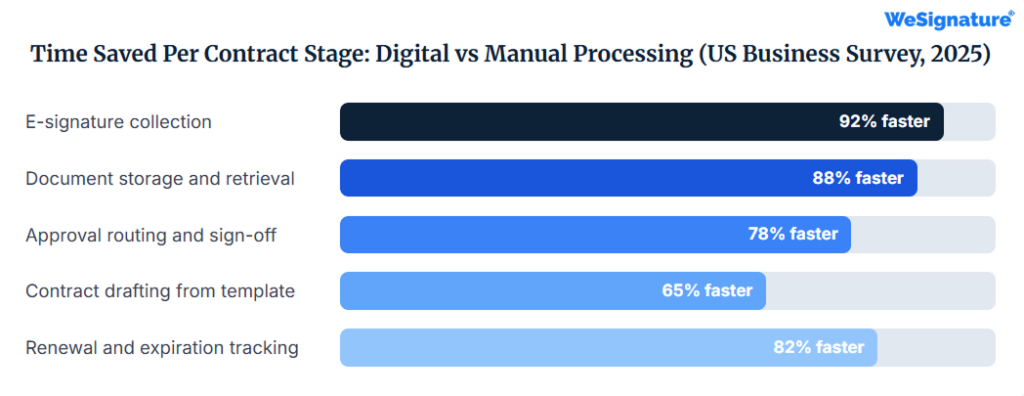
Chart Description: Average time savings per contract lifecycle stage when using digital contract management versus fully manual processes (email, shared drives, paper signatures). Data compiled from APQC contract process benchmarking and US SMB digital transformation survey data, 2025. Results reflect median improvement across organizations of 10 to 500 employees.
How the Top Contract Management Platforms in the USA Compare
The US market has a wide range of contract management tools, from enterprise CLM platforms built for Fortune 500 legal departments to lightweight e-signature tools designed for SMBs. Choosing the wrong tier for your organization’s size and volume is one of the most common implementation mistakes.
According to APQC benchmarks, over-featured enterprise CLM implementations at small companies fail to achieve adoption within the first year because the workflow complexity exceeds the team’s capacity to manage it.
For most US small and mid-sized businesses, the right tool is one that covers the core lifecycle stages, including templates, workflow routing, e-signatures, a repository, and an audit trail, without requiring a dedicated contract operations team to run it. Compare platforms on e-signature software features and price before committing to an annual plan, especially for teams under 50 users, where the cost difference between platforms is significant.
When comparing digital contract management software, small businesses should focus less on enterprise feature lists and more on the workflows they actually use every week: approvals, e-signatures, storage, audit trails, and renewal tracking.
| Platform | Starting Price | E-Signature | Workflow Automation | Audit Trail | Best For |
| WeSignature | From $8/mo | Yes | Yes | Full | SMBs, startups, growing teams |
| DocuSign | From $25/user/mo for standard e-signature plans; CLM may require enterprise evaluation | Yes | Advanced on higher tiers | Full | Larger teams and enterprise legal workflows |
| Adobe Acrobat Sign | Varies by region and plan | Yes | Limited to moderate | Full | Adobe ecosystem users |
| PandaDoc | From $19/user/mo | Yes | Yes | Full | Sales teams and proposal workflows |
| ContractSafe | From $450/mo | No native e-signature on entry plan; integrations available | Limited to moderate | Full | Contract repository use cases |
| Ironclad | Custom enterprise pricing | Yes | Advanced | Full | High-volume enterprise CLM |
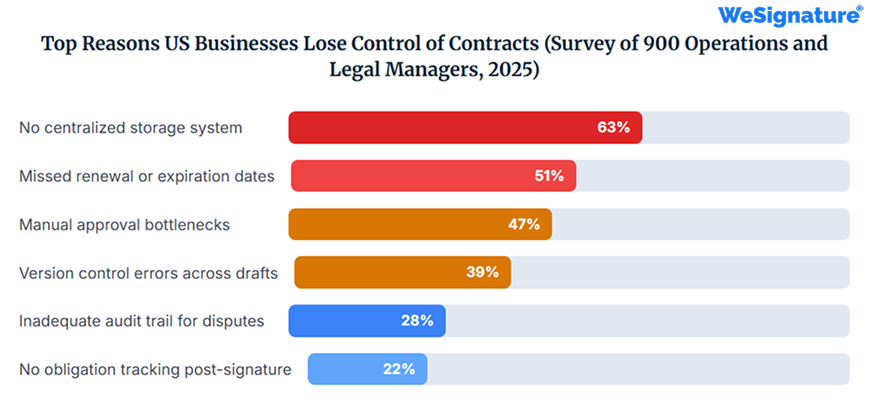
Chart Description: Primary reported failure points in US business contract management, based on responses from 900 operations managers, in-house legal staff, and CFOs. Respondents could select multiple factors. Percentages reflect the share of respondents citing each factor as a significant or primary issue in their current contract management process.
Common Digital Contract Management Mistakes to Avoid in Your Business
Adopting a digital contract management system does not automatically solve the problems of a manual process. The most common mistakes organizations make when transitioning are worth flagging directly because they are the reason many implementations fail to deliver measurable results in the first year.
Migrating contracts without cleaning metadata. Importing thousands of legacy contracts without standardizing fields (expiration dates, contract owners, counterparty names) creates a digital repository that is just as hard to search as the old shared drive. Dedicate time upfront to defining your metadata schema before mass import.
Using e-signatures without configuring audit trails. Every major platform supports detailed audit logs, but they are not always enabled by default. Verify that your configuration captures signer authentication method, IP address, timestamp, and document fingerprint for every signature event. For US legal disputes, this is the evidentiary detail that matters.
Skipping template governance. Creating a template library is not a one-time task. Templates need an owner, a review cycle (at a minimum annually), and a version control process. A template that reflects outdated regulatory language or expired vendor terms is a liability, not an asset.
Treating renewal tracking as optional. Teams that configure renewal alerts but do not assign a specific owner to act on those alerts still miss deadlines. The alert is the trigger. The process that follows the alert (who reviews the contract, who initiates the renewal conversation, and who has authority to sign the new terms) needs to be defined and documented.
Compare Before You Pay for Enterprise CLM
DocuSign is a well-known name in e-signatures and contract workflows, especially for larger organizations with complex legal processes. But many small and mid-sized businesses do not need a heavy enterprise CLM rollout to manage everyday agreements, approvals, renewals, and signatures.
WeSignature gives growing teams the practical contract tools they actually use: legally binding e-signatures, workflow automation, secure document storage, completion tracking, and full audit trails in a simpler platform built for speed and affordability.
Before committing to a complex CLM setup, compare whether WeSignature can cover your real contract workflow at a lower cost and with faster adoption.
Digital Contract Management Is Not Optional Anymore
The gap between organizations that manage contracts digitally and those that still rely on email chains and shared drives is widening every year. Businesses running on manual contract processes are leaving measurable revenue on the table, absorbing compliance risk they cannot see, and losing competitive time in every deal cycle because their approvals and signatures take days longer than they should.
The best practices in this guide are not aspirational. They are the operational baseline that high-performing contract teams in the US have already standardized around: centralized repositories, template libraries, automated workflows, e-signatures with full audit trails, renewal alerts, and KPI tracking. Each practice solves a specific, documented failure point in manual contract management.
Implementing all seven does not require enterprise software or a dedicated contract operations team. It requires choosing the right platform for your volume, configuring it correctly, and assigning ownership to each stage.
WeSignature provides the e-signature infrastructure, workflow automation, and audit trail capabilities that cover the execution and compliance layers of that system at a price point built for teams of any size across the US. Start with the stage where your contracts break down most often, and build from there.
Frequently Asked Questions About Digital Contract Management
1. What is digital contract management?
Digital contract management is the process of creating, reviewing, signing, storing, and tracking contracts using software instead of paper files, email threads, spreadsheets, or shared drives. It helps businesses manage the full contract lifecycle from drafting through renewal.
2. What are the main benefits of digital contract management?
The main benefits include faster contract approvals, fewer drafting errors, legally binding e-signatures, centralized contract storage, automated renewal reminders, better compliance tracking, and a complete audit trail for every contract action.
3. Is digital contract management only for large companies?
No. Small and mid-sized businesses can benefit from digital contract management, especially if they handle vendor agreements, sales contracts, NDAs, employment documents, proposals, or recurring service agreements. SMBs often need simpler tools that cover e-signatures, workflow automation, storage, and tracking without full enterprise CLM complexity.
4. Are electronic signatures legally binding in the United States?
Yes. Electronic signatures are generally legally binding in the United States under the federal ESIGN Act and state-level electronic transaction laws. UETA has been adopted in 49 states, while New York has its own similar electronic signature law. Some document types may require special handling, so businesses should confirm requirements for regulated or high-risk agreements.
5. What features should digital contract management software include?
Good digital contract management software should include reusable templates, approval routing, a secure contract repository, legally binding e-signatures, renewal reminders, role-based access, document status tracking, and a tamper-evident audit trail.
6. How does WeSignature help with digital contract management?
WeSignature helps businesses manage contracts with legally binding e-signatures, workflow automation, secure document storage, signing status tracking, and audit trails. It is built for teams that want a simpler and more affordable way to manage everyday agreements without adopting a complex enterprise CLM platform.
