
How to Write a Contract: Step-by-Step Guide + Considerations
In an era of remote work, global partnerships, and on-demand services, handshake agreements are becoming relics. Modern businesses rely on well-constructed contracts to clarify obligations, protect their interests, and keep projects on track.
With the rise of digital workflow tools, electronic signatures have become mainstream – more than two-thirds of large companies now operate “digital-first” and prefer e-signatures over paper, while banking and insurance firms account for roughly 26 % of all e-signature users.
Even customers expect digital convenience: a recent survey found that over 90 % of bank customers opt to sign documents electronically when given a choice.
A report by Grand View Research, analysts estimate the digital signature industry will surge from about $5.2 billion in 2024 to more than $38 billion by 2030, with annual growth rates exceeding 40
With those trends in mind, learning how to draft and execute contracts isn’t just a legal nicety – it’s a survival skill for doing business in 2025 and beyond. This guide will provide a straightforward explanation of the process ahead. You’ll understand the essentials, the most important components every contract should contain, and practical steps to develop agreements you can depend on. Regardless of whether you are working with a freelancer, hiring a vendor, or partnering with a co-contractor, these tips will help you avoid surprises and keep everyone on the same page.
The Value of a Written Contract
A written contract is more than a piece of paper; it is a shared commitment that describes rights, obligations, and remedial measures. Clear contracts:
- Hold parties accountable: By documenting obligations, parties establish clarity and provide both parties with an unambiguous plan to deliver goods or perform services.
- Decrease the chances of disagreement: Well-drafted contract clauses make it less likely that misunderstandings, deadlines, or payments will become an issue.
- Protect cash flow: Contracts include details about remuneration, timing for payments and penalties for failure to perform.
- Provide a basis for action in the event of disagreement: If an issue arises, you can rely on the contract to enforce obligations, recoup damages, or terminate the contract as an alternative to further liability.
- Save time and money: A well-articulated contract eliminates the need to negotiate back and forth and can potentially save you money at some future time in litigation or negotiation with involved professionals.
Going digital has the potential to enhance the contract even further! Electronic signatures slash turnaround time and eliminate printing and mailing costs. Many organizations find their deals close nearly a third faster once they adopt e-signatures. And you can trust their legal status: U.S. laws like the ESIGN Act and UETA, along with Europe’s eIDAS framework, treat e-signatures as fully binding.
Examples of When to Use a Contract
Contracts come in many flavors, from simple statements of work to complex multi-year agreements. You should consider one whenever money, intellectual property, confidentiality, or liability are at stake. Common use cases include:
- Employment agreements
- Service provider engagements
- Real estate and rental agreements
- Consulting or freelance agreements
- Partnership agreements and joint-venture agreements
- Licensing agreements and IP transfers
- SaaS, software, and digital subscriptions guarantee data privacy and cancellation terms.
- Vendor agreements or supplier agreements, delivery, pricing, and remedies for delayed and/or non-delivery.
If, at any point, you are unsure whether or not to execute a contract, err toward writing one. Preemptively spending the time up front on a clear document will save you later in possible disputes and misunderstandings.
A Legal Perspective on Contracts
From a legal perspective, a legally binding, written contract is much more than just a sheet of paper with a signature on it; it is a legally binding agreement. Contracts are not enforceable unless, at a minimum, one of the following typically occurs:
1. Offer and acceptance: one party proposes certain terms and the other party accepts that offer without materially changing any of the terms.
2. Consideration: There has to be something of value exchanged. This can be money, services, intellectual property, or even an agreement not to do something.
3. Mutual Consent: Both parties agree. Beyond these elements, current-day contracts should acknowledge applicable statutes and regulations. For example, if you are relying on electronic signatures, it may be prudent to cite statutes like the ESIGN Act or the European eIDAS regulation to bolster enforceability. You may also wish to include clauses regarding data privacy compliance (e.g., GDPR, CCPA) if you are exchanging personal information.
Elements All Contracts Should Contain.
A complete contract will have a consistent organization. Below are typical sections that can be used to clarify roles and responsibilities:
Party Information
List each party’s full legal name, business form (i.e., LLC, corporation, sole proprietorship), and contact information. This helps ensure clarity about who is bound by the agreement. Use, address, phone numbers, and email addresses.
Agreement Terms
Provide details about: What will be exchanged; When the exchange will occur; How the exchange will happen; and for how much money. Be clear regarding services, deliverables, intellectual property, payment, milestones, and criteria for performance. Specify whether work products are “works made for hire” and who will have ownership of the intellectual property that is assigned or created.
Cancellation
Include an explanation of the conditions under which either party may cancel the contract. Termination conditions are often based on non-payment, lack of performance, bankruptcy, and/or breach of confidentiality. Be sure to include notice requirements and specify penalties and remedies, if any are applicable, upon termination.
Indemnification
An indemnification clause protects one party for damages and any claims that arise from either party’s actions. These generally specify who is responsible for attorney fees and damages, if harmed by a third party suing under the contract.
Dispute Resolution
Determine the manner in which disputes will be resolved (negotiation, mediation, arbitration, or litigation). Indicate the laws of the jurisdiction that will govern the contract. If you are forming a contract that crosses borders, consider whether you need to use a forum selection clause to clarify which countries’ courts will have jurisdiction.
Date & Signatures
Make sure to specify when the contract becomes effective, and that it is signed by the individuals who are authorized to sign for the parties. If signatures may be obtained electronically, add language confirming that the parties agree to sign electronically. Most platforms will maintain an audit trail to show when and how each signature was obtained.
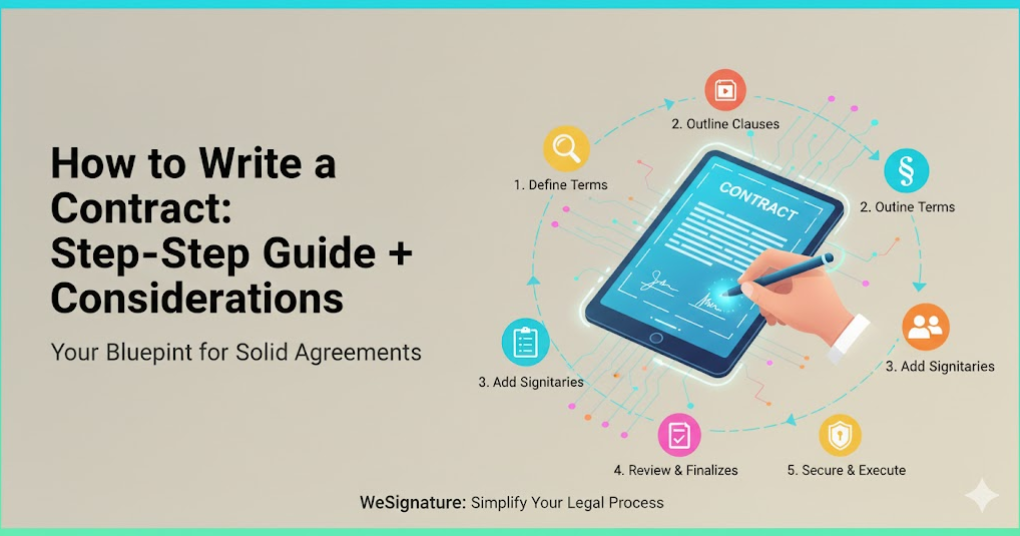
How to Write a Contract in 5 Steps
Writing a contract can feel daunting, but breaking the process into manageable steps helps. Here’s a framework:
Step 1: Choose a Relevant Template
Start with a template suited to your transaction type. For example, if you’re hiring a freelancer, a consulting agreement template may suffice; for software licensing, use a licensing template. Many industry associations and legal sites offer templates that comply with applicable laws. Using a template ensures you don’t miss critical clauses.
Step 2: Outline Parties & Basic Information
Fill in the parties’ names, legal entities, addresses, and other identifying information. Clarify whether the signatories have the authority to represent their organization. For larger deals, include recitals—brief paragraphs explaining the context and goals of the contract.
Step 3: Detail Terms of the Agreement
Clearly state the scope of work, deliverables, payment schedules, and responsibilities. Use numbered lists, bullet points, and defined terms to organize information. Include confidentiality obligations, ownership of intellectual property, warranties, indemnification, and limitations of liability. Make sure the language is precise and consistent.
Step 4: Define Length & Exit Plans
Specify the contract’s effective date, duration, and renewal provisions. Explain how either party can terminate the agreement, under what circumstances, and what happens if the contract ends early. Include clauses for extension or automatic renewal if desired.
Step 5: Sign & Securely Archive
Have authorized representatives review and sign the contract. For speed and security, use a reputable e-signature platform that provides an audit trail and meets legal requirements. Once executed, store the contract in a secure repository (digital or physical) with backups. Implement a system for reminding stakeholders about renewal dates and milestone obligations.
Top Tips for How to Write a Contract
- Use clear, plain language: Avoid legal jargon whenever possible. Contracts should be easy to read so all parties understand their obligations.
- Be consistent with terms: Define key terms once and use them consistently. For example, don’t interchange “Company” and “Service Provider” to describe the same entity.
- Define responsibilities precisely: Detail tasks, timelines, and quality standards. Vague language invites confusion and disputes.
- Keep contracts updated: Review and revise contracts periodically to reflect changes in law, business goals, or market conditions. Add amendments rather than rewriting the entire contract where appropriate.
- Consider professional advice: For complex or high-stakes agreements, consult a lawyer. Legal professionals can flag potential issues and tailor clauses to your jurisdiction.
- Keep it simple: A contract doesn’t need to be long to be effective. Short, well-structured agreements often reduce misunderstandings and negotiation time.
FAQs About How to Write Contracts
What makes a contract legally binding? A contract is legally binding when it includes an offer, acceptance, consideration, mutual consent, capacity, and a lawful purpose. Signing—whether wet ink or electronic—demonstrates intent to be bound.
Are electronic signatures legally valid? Yes. In the U.S., federal law (the ESIGN Act) and state laws (e.g., UETA) give electronic signatures the same legal status as handwritten signatures. In the European Union, the eIDAS regulation governs electronic signatures. Choose a compliant platform that offers authentication and audit trails.
Do I need a lawyer to draft a contract? Not always. For straightforward agreements, templates may suffice. However, for complex transactions or high-stakes deals, consulting a lawyer ensures your contract complies with local laws and protects your interests.
How long should I keep a contract? Retain contracts for at least the duration of the agreement plus any applicable statute of limitations. Many businesses keep records for six to ten years. Electronic archiving makes long-term storage and retrieval easier.
What happens if someone breaches the contract? The non-breaching party may be entitled to remedies, such as termination, payment of damages, or specific performance. The contract itself should outline the steps to take, including any cure periods or dispute resolution mechanisms.
Final Thoughts
Writing a contract isn’t just a box to tick — it’s a strategic tool that sets expectations, builds trust, and protects everyone involved. As more companies embrace digital workflows, contracts are faster to draft, sign, and manage than ever before. Banking and finance have already moved online, and analysts believe the digital signature market will continue to expand rapidly over the coming years. Whether you’re a startup founder, a freelancer, or a corporate executive, knowing how to craft clear, concise contracts will help you collaborate effectively and reduce risk. Use the steps and best practices in this guide to create agreements with Wesignature that stand up to scrutiny and support your business goals.
