Remote Online Notarization (RON) Guide for US Businesses in 2026
Key Takeaways
- Remote online notarization (RON) lets a notary and signer complete the entire notarization process over a live, secure video call without being in the same room.
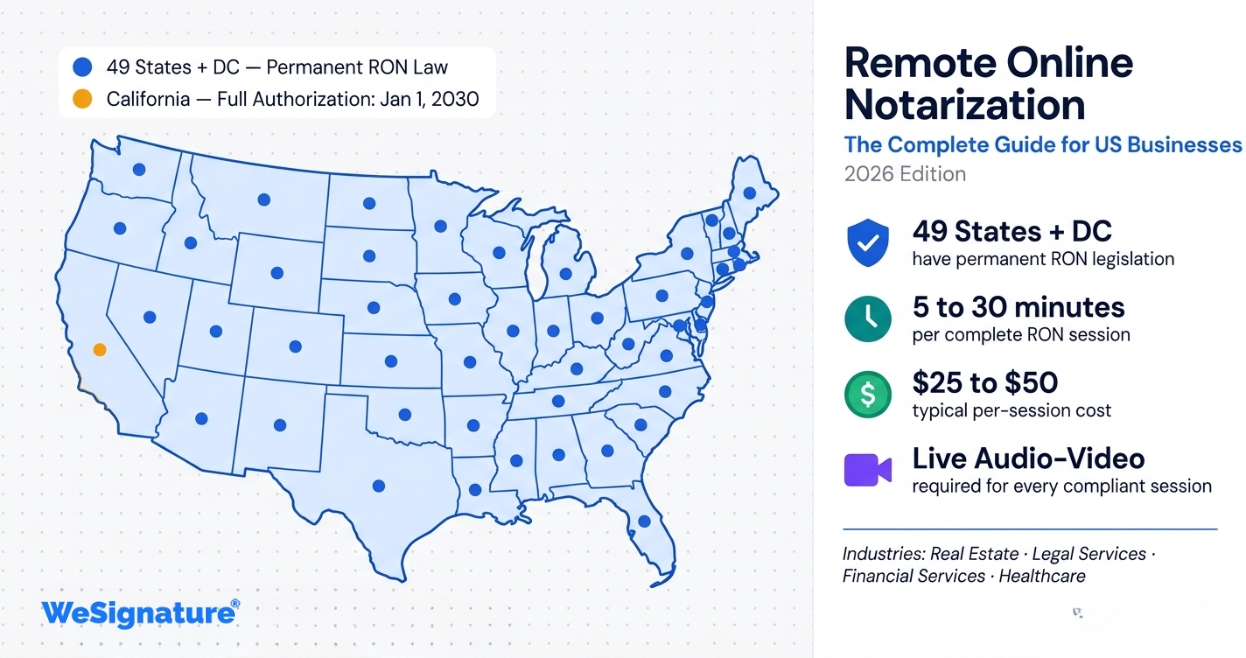
- As of 2026, 49 states plus Washington DC have enacted permanent RON legislation. California is the only state without full permanent authorization, with broad RON expected by January 1, 2030.
- A typical RON session takes 5 to 30 minutes from start to finish, compared to hours or days for traditional in-person or mail-based notarization.
- RON sessions cost $25 to $50 on most US platforms, often less expensive than a mobile notary when travel fees are factored in.
- Real estate, legal services, financial services, and healthcare are the four industries driving the highest RON adoption in the US.
- All compliant RON platforms require multi-factor identity verification, a live audio-video session, a tamper-evident electronic seal, and secure storage of the recorded session.
- The federal SECURE Notarization Act, if passed, would standardize RON requirements nationwide, removing the current patchwork of state-by-state rules.
Remote online notarization is one of the most consequential shifts in how US businesses handle high-stakes documents, and in 2026, it is no longer an emerging trend. It is an operating infrastructure. As of this year, 49 states and the District of Columbia have enacted permanent RON legislation, and the remaining holdout, California, has a phased rollout underway with full authorization expected by 2030.
For businesses in real estate, legal services, financial services, insurance, and healthcare, understanding remote online notarization is not optional. Documents that once required an in-person meeting, a physical seal, and days of scheduling can now be completed in a single, secure video session from any location. The time savings alone change how deals are structured and how quickly they close.
This guide covers everything a US business needs to know about RON in 2026: what it is, how it works step by step, which states allow it, what it costs, which documents qualify, how it compares to traditional notarization, and how it connects to your broader eSignature workflow.
If you have read our overview of eSignature trends in 2026, RON was identified as one of the six defining trends reshaping the market. This guide goes deeper into that topic.
Where RON Fits Into a Digital Signing Workflow
Most business documents do not need notarization. They only need a secure, compliant electronic signature workflow with signer authentication, audit trails, document tracking, reminders, and secure storage.
RON becomes relevant when a document specifically requires a notarial act. In that case, remote online notarization works as an additional layer on top of the digital signing process.
WeSignature helps businesses manage the eSignature side of this workflow, including document preparation, multi-party signing, audit trails, and secure digital execution. For documents that require notarization, businesses can combine an eSignature workflow with a RON provider or a notarial process accepted by the receiving party.
What Is Remote Online Notarization (RON)?
Remote online notarization is the process of notarizing a document entirely online, using electronic signature technology, multi-step identity verification, and a live audio-video session. The notary public and the signer are not required to be in the same physical location.
Instead, they connect through a secure, approved RON platform where the signer’s identity is verified, the document is signed electronically, and the notary applies a digital seal, all in real time.
What makes RON different from simply sending a document for an electronic signature is the formal legal structure around it. A notarization is a specific legal act that certifies a signer’s identity and their willingness to sign without coercion.
RON carries the same legal weight as in-person notarization in states where it is authorized, because it meets the same fundamental requirements: verified identity, witnessed signing, and a notarial seal tied to a tamper-proof record.
RON vs. Other Notarization Types
There are three primary forms of modern notarization, and the differences matter when evaluating which method applies to a specific document or workflow.
| Notarization Type | Signer Location | Notary Location | Document Format | Video Required |
| Traditional In-Person | Same room as the notary | Same room as signer | Paper | No |
| In-Person Electronic (IPEN) | Same room as the notary | Same room as signer | Digital | No |
| Remote Ink-Signed Notarization (RIN) | Any location | Any location | Paper, mailed back | Yes, for signing |
| Remote Online Notarization (RON) | Any location | Any location | Fully digital | Yes, full session |
Table Description: Comparison of the four main notarization types available to US businesses in 2026. RON is the only fully digital, fully remote notarization method with no physical document exchange required. Sources: OneSpan, NotaryCam (2026).
How Remote Online Notarization Works: A Step-by-Step Breakdown
The RON process is designed to be completed entirely within a secure digital platform. Most sessions take between 5 and 30 minutes from start to finish. Here is what each step involves.
1. Document Upload
The sender or signer uploads the document to a RON-compliant platform. The document is encrypted and stored securely throughout the session. Fields for signature, initials, and the notary seal are tagged in advance.
2. Identity Verification
The signer completes multi-factor identity verification. This includes Knowledge-Based Authentication (KBA), a series of questions drawn from public and private records that only the signer should be able to answer, and credential analysis, which involves scanning a government-issued photo ID such as a driver’s license or passport. Some platforms also use biometric facial recognition.
3. Live Audio-Video Session
The signer and the commissioned notary connect through a secure, recorded video call on the platform. No downloads or plugins are typically required. The notary confirms the signer’s identity, witnesses the electronic signing in real time, and verifies that the signer is acting willingly.
4. Electronic Signing and Notarial Seal
The signer applies their electronic signature to the document during the live session. The notary then affixes their official electronic seal and digital signature. The seal is tamper-evident, meaning any alteration to the document after sealing is detectable.
5. Session Recording and Secure Storage
The entire video session is recorded and stored securely by the platform, typically for a minimum period required by state law (often five to ten years). The recording serves as legally admissible evidence if the notarization is ever challenged. An audit trail documenting every action taken during the session is also generated automatically.
Remote Online Notarization Laws by State in 2026
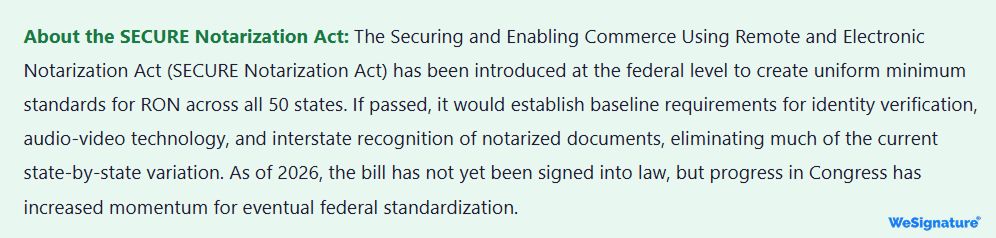
According to FindNotary.io’s 2026 RON state guide, 49 states plus the District of Columbia have enacted permanent RON legislation as of 2026. Virginia was the first state to authorize RON permanently, back in 2012. Texas, Florida, Nevada, Michigan, Ohio, and Pennsylvania are among the most active RON markets for real estate and legal services.
California remains the only state without full permanent RON authorization. A phased rollout is underway, with permanent broad authorization expected by January 1, 2030. California residents can currently use RON services through notaries commissioned in other states, which is legally permissible under most state RON frameworks. If your business operates primarily in California, it is important to verify document acceptance with the receiving party before using an out-of-state RON notary.
The National Notary Association tracks all active state RON legislation and is the most authoritative source for verifying current requirements in your state.
A key practical rule for US businesses: the RON session is governed by the laws of the state where the notary is commissioned, not where the signer is physically located. This means a notary commissioned in Texas can legally notarize a document for a signer located in California, as long as both the notary’s platform and the document type comply with Texas RON law.
Always confirm acceptance with the receiving party (a bank, court, title company, or government agency) before proceeding.
Which US Industries Use Remote Online Notarization Most
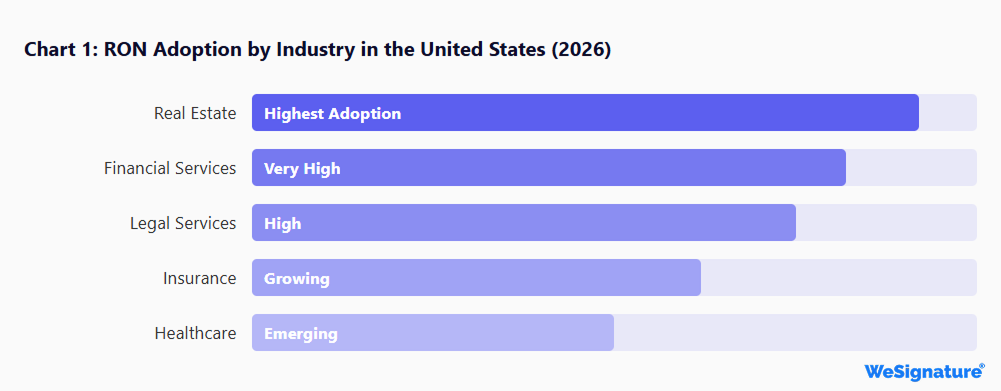
Chart 1: Relative RON adoption by industry in the US, based on transaction volume and sector-level research from NotaryCam (2026) and industry analysis from Data Insights Market (2025). Bars represent relative adoption ranking, not exact percentages, as sector-specific RON volume data is not uniformly published.
Real Estate
Real estate is the highest-volume RON use case in the United States. Mortgage documents, property deeds, refinance packages, and closing paperwork all frequently require notarization. RON allows buyers, sellers, and lenders to complete closings entirely online, eliminating the need to coordinate in-person schedules across multiple parties.
This is particularly valuable for out-of-state buyers, investors managing remote transactions, and lenders servicing clients across multiple markets. Our real estate eSignature guide covers how these workflows fit together from offer to close.
Legal Services
Law firms use RON for powers of attorney, affidavits, living wills, trusts, court filings, and corporate agreements. The ability to notarize documents without requiring a client to appear in person is especially valuable for clients with mobility limitations, clients located in different states, and time-sensitive legal matters where delays create material risk.
US law firms with a digital-first practice model treat RON as a core service differentiator, as covered in our legal professionals guide.
Financial Services and Insurance
Banks, lenders, and insurance carriers use RON to streamline loan origination, account opening, and policyholder documentation. According to NotaryCam’s financial services guide, financial institutions adopting RON reduce reliance on manual tasks, including printing, mailing, scanning, and physical document storage, resulting in measurable efficiency gains across mortgage closings and wealth management transactions.
For insurance agents working across state lines, RON enables policy-related documents that require notarization to be executed without the policyholder appearing in person, which directly reduces abandonment rates for complex policies.
Healthcare
Healthcare is a growing RON use case because patients, caregivers, and providers often need to complete time-sensitive documents without requiring travel to an office. Medical directives, advance care documents, HIPAA authorizations, and certain consent forms that require notarization can be completed remotely, which is particularly important for patients in assisted living facilities, patients recovering at home, or anyone who cannot travel to an office for a signature.
The growth in healthcare RON activity is measurable at the platform level: NotaryCam reported a 45% increase in medical credentialing remote notarizations in 2023 alone, according to the company’s March 2024 press release.
RON vs. eSignature: What Is the Difference?
An electronic signature confirms that a signer agreed to a document electronically. For most business documents, such as NDAs, sales contracts, employment agreements, vendor agreements, and proposals, a compliant eSignature is enough.
Remote online notarization is different. RON includes a commissioned notary, identity verification, a live audio-video session, electronic signing, and a digital notarial seal. It is only needed when the document requires notarization.
| Document Type | eSignature Usually Enough? | RON May Be Required? |
| NDA | Yes | No |
| Sales contract | Yes | No |
| Employment agreement | Yes | No |
| Vendor agreement | Yes | No |
| Power of attorney | Sometimes | Yes |
| Affidavit | Sometimes | Yes |
| Deed or mortgage | Sometimes | Yes |
| Healthcare directive | Depends | Yes |
What Documents Can Be Notarized Remotely in the United States
The range of documents that qualify for RON varies somewhat by state, but most US states allow RON for a broad set of document types. The following categories cover the most common business use cases.
| Document Category | Common Examples | State Restrictions |
| Real Estate | Deeds, mortgages, refinance packages, title documents | Most states permit RON, but lender and county recorder requirements may vary |
| Legal Documents | Powers of attorney, affidavits, living wills, trusts | Generally permitted, but some states require witnesses or special execution rules |
| Corporate Documents | Articles of incorporation, business agreements, contracts | Broadly permitted in most RON states |
| Financial Documents | Loan agreements, account opening forms, promissory notes | Check lender, bank, and institution-specific requirements |
| Healthcare Directives | Advance directives, healthcare proxies, HIPAA authorizations | State rules vary; verify with legal counsel or the receiving institution |
| Personal Documents | Sworn statements, parental consent forms, and name change documents | Generally permitted, but acceptance depends on document type and receiving party |
Table Description: Common document categories eligible for Remote Online Notarization in the US. Some states restrict RON for specific document types, particularly those requiring physical witnesses. Always verify eligibility with the receiving party and your state’s RON statute. Sources: NotaryCam (2026), FindNotary.io (2026).
One important note: certain documents are generally excluded from RON in most states. These include Wills in many jurisdictions (which require physical witnesses present), some court-filed documents requiring specific judicial certification, and documents where the receiving agency (such as a foreign government) does not accept electronically notarized records. When in doubt, confirm with the institution or court that will receive the document.
RON Cost vs. Traditional Notarization: What US Businesses Actually Pay
One of the most common questions from businesses evaluating RON is whether it is actually less expensive than traditional notarization once platform fees are factored in. The comparison depends heavily on the use case and how frequently notarizations are needed.
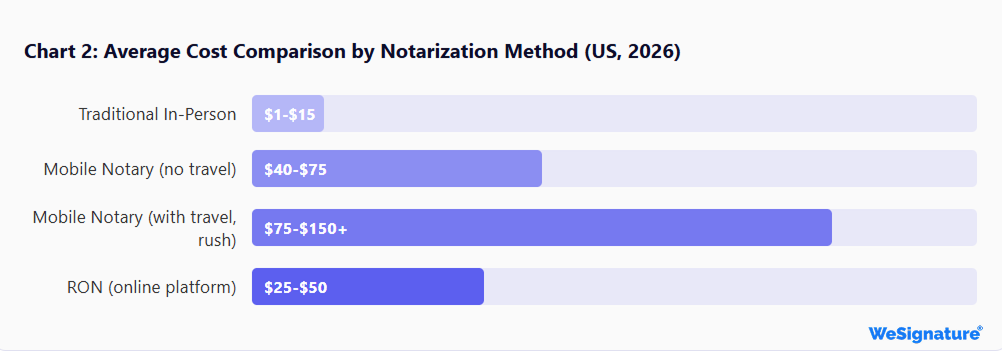
Chart 2: Average cost per notarization session by method for US businesses in 2026. Traditional in-person costs reflect state-capped notarial act fees only. Mobile notary costs include typical travel and convenience fees. RON costs reflect per-session platform pricing from major US providers. Sources: NotaryCam (2026), NotaryLive (2026), NotaryLotus (2026).
Traditional in-person notarization at a bank or UPS store typically costs $1 to $15 per signature, based on state-capped notarial act fees. However, this comparison is misleading for business workflows because it excludes the cost of staff time, travel, scheduling delays, and document courier or mailing expenses.
A mobile notary who comes to your office adds convenience but typically charges $40 to $75 for a standard daytime visit, with after-hours or rush appointments reaching $100 to $150 or more. RON sessions through platforms like Notarize, Proof, or NotaryLive typically cost $25 to $50 per session, including identity verification, the live notary, and the sealed digital file. For high-frequency business users, many RON platforms offer subscription pricing that reduces the per-session cost further.
When travel time, scheduling overhead, and document handling are fully accounted for, RON is typically more cost-effective than mobile notarization for most US business use cases. The economics are especially clear in industries like real estate and legal services, where notarized documents are frequent and time-sensitive.
How Remote Online Notarization Connects to Your eSignature Workflow
RON does not replace your existing eSignature process. It extends it. Most documents a business handles daily do not require notarization. Standard contracts, NDAs, employment agreements, vendor agreements, and client proposals are fully executed with an electronic signature alone. RON is relevant only to the subset of documents for which a notarial act is legally required.
The most effective implementation of RON for a US business is one where it operates as an additional layer within an already mature eSignature workflow. This means your signing platform handles the bulk of your document execution, and your RON-enabled process is triggered specifically for notarization-required documents.
Platforms that offer native integrations between eSignature and RON tools eliminate the need to duplicate document preparation or communication with signers across two separate systems.
WeSignature supports the eSignature component of this workflow with ESIGN and UETA-compliant signing, multi-party workflows, and audit trails that can accompany RON documentation packages. For businesses wanting to understand the full security and compliance picture around digital document processes, our electronic signature security guide covers encryption standards, authentication methods, and audit trail requirements in detail.
When evaluating how RON fits into your operations, the key question is volume: how many documents per month require notarization, and what is the current cost in time and money to get them notarized?
For most businesses that have answered this honestly, the case for RON integration is straightforward. You can also explore how to structure these processes efficiently with our contract management guide.
Final Thoughts
Remote online notarization has moved well past the pilot phase. With 49 states plus DC operating under permanent RON legislation in 2026, the legal infrastructure is firmly in place. The technology requirements, multi-factor identity verification, live audio-video sessions, tamper-evident digital seals, and secure session recording, are mature, standardized, and available through multiple US-based platforms at a cost that is competitive with traditional mobile notary services.
For US businesses in real estate, legal services, financial services, insurance, and healthcare, the question is no longer whether RON is legitimate. It is how quickly your workflows can incorporate it. The businesses that have already made this shift are closing faster, serving clients across wider geographies, and spending less time coordinating in-person logistics for documents that can be fully executed digitally.
If your eSignature process is already in place, adding RON capability for notarization-required documents is the logical next step in building a fully digital document workflow. Start by identifying which document types in your operations require notarization, verify your state’s RON statute, and evaluate which platform best fits your volume and integration needs.
For most businesses, RON is not a replacement for eSignature. It is a specialized layer used when notarization is required. WeSignature helps teams digitize the broader signing workflow, including document preparation, signer routing, audit trails, and secure electronic execution. If your business handles contracts, approvals, forms, or agreements at scale, building a reliable eSignature workflow is the first step toward a fully digital document process.
Disclaimer: This article is for general informational purposes only and is not legal advice. RON rules vary by state, document type, receiving party, and notary commission. Always confirm requirements with the receiving institution, title company, court, or legal counsel.
Frequently Asked Questions About Remote Online Notarization
What is remote online notarization (RON)?
Remote online notarization is a legally recognized process that allows a notary public and a signer to complete a notarization entirely online through a secure audio-video platform, without being in the same physical location. The process includes multi-step identity verification, a live recorded video session, electronic signing, and the application of a tamper-evident digital notary seal. As of 2026, 49 states plus Washington DC have enacted permanent RON legislation, giving electronically notarized documents the same legal standing as traditionally notarized ones.
Is remote online notarization legal in all 50 US states?
As of 2026, 49 states plus the District of Columbia have enacted permanent RON legislation, making remote online notarization legally valid in nearly all of the United States. California is the one exception: permanent broad RON authorization for California-commissioned notaries is expected to take effect on January 1, 2030, though a limited pilot program is currently available, and California residents may use out-of-state RON notaries for many document types. Always confirm acceptance with the party receiving your notarized document, as institutional requirements can vary.
How much does remote online notarization cost?
Remote online notarization typically costs $25 to $50 per session through major US RON platforms, including the notary’s fee, identity verification, and secure digital storage of the recorded session. This is generally comparable to or less expensive than hiring a mobile notary once travel fees are included, which commonly range from $40 to $75 for a standard daytime visit and can exceed $100 for rush or after-hours appointments. High-volume business users can often access subscription pricing on RON platforms to further reduce per-session costs.
What types of documents can be notarized remotely?
Most business and legal documents that require notarization are eligible for RON, including real estate documents such as deeds and mortgages, powers of attorney, affidavits, living wills, trusts, corporate agreements, loan documents, and certain healthcare directives. The specific eligibility depends on your state’s RON statute and, importantly, whether the receiving party, such as a bank, court, or title company, will accept electronically notarized records. Documents that typically cannot be notarized remotely include wills in many states (which require physical witnesses) and documents filed with foreign governments that do not recognize RON.
What is the difference between an eSignature and remote online notarization?
An electronic signature confirms that a specific person signed a document, supported by audit logs, timestamps, and identity verification. It is legally sufficient for the vast majority of business contracts and agreements under the ESIGN Act and UETA. Remote online notarization goes a step further: it involves a licensed notary public who verifies the signer’s identity in real time via video, witnesses the signing, and applies an official notarial seal to the document. RON is required only for specific document types that are legally mandated for notarization, such as real estate deeds, powers of attorney, and certain court filings. For all other business documents, a compliant eSignature is fully sufficient.