What is a Signature Block? It's purpose, components, and types
Key Takeaways
- A signature block is more than just a name — it includes your title, contact details, and signature, all in one structured section.
- It plays a critical role in document authentication, sender identification, and legal clarity.
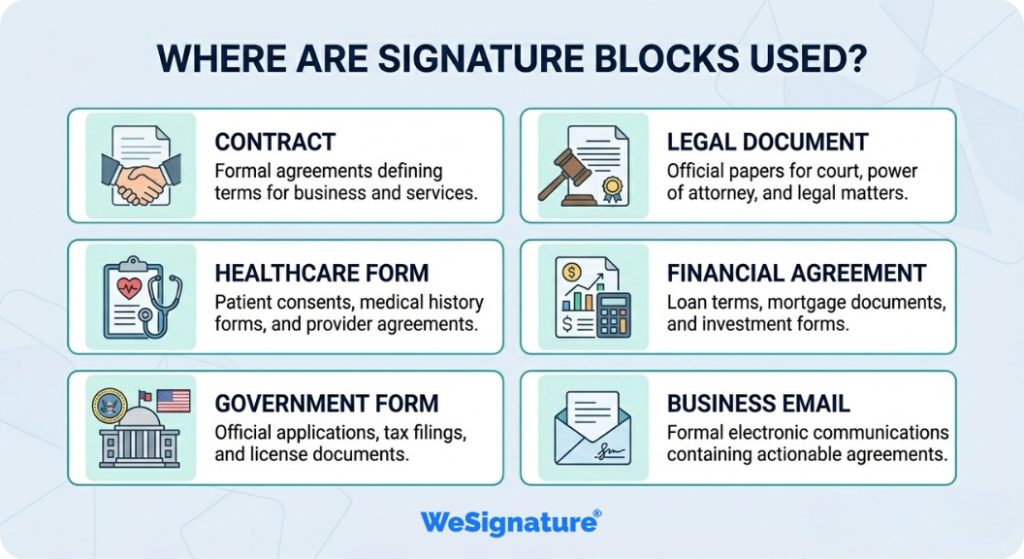
- Signature blocks appear in contracts, legal documents, healthcare forms, government forms, and business emails.
- Electronic signature blocks offer stronger security through encryption, biometrics, and OTP verification.
- Using a reliable electronic signature software makes creating and managing signature blocks faster and more professional.
Introduction
Every professional document you’ve ever signed — a contract, an offer letter, a lease agreement — had one thing in common at the bottom: a structured section with a name, title, and signature. But have you ever stopped to think about why that section looks the way it does, or what legal and professional weight it carries?
That section is called a signature block, and it’s far more than a formality. Whether you’re closing a business deal, signing a healthcare directive, or sending a formal email, a well-structured signature block identifies who you are, authenticates your agreement, and communicates your authority — all at once.
In this article, you’ll learn exactly what a signature block is, why it matters, what goes into one, and how different industries use them.
What is a Signature Block?
A signature block — also called a signature line or signature area — is a structured section typically placed at the end of a document, email, or formal communication. It contains the signer’s name, job title, organization, contact information, and either a handwritten or electronic signature.
In most professional emails and contracts, you’ll notice the sender’s details neatly arranged beside or below their signature. That organized set of information is the signature block.
It serves five core functions: identifying the sender, authenticating the document, conveying the signer’s authority, providing contact details, and projecting a professional image in business and legal communications
What is the Purpose of a Signature Block?
The signature block isn’t just decorative — each element serves a specific communication and legal purpose:
Sender Identification: Clearly states who sent the document, including their name, role, and organization — eliminating any ambiguity about the source.
Document Authentication: Confirms that the content came from the stated sender, reducing the risk of forgery or unauthorized alterations.
Transfer of Authority: Communicates the signer’s position and responsibility within an organization, which matters particularly in contracts and legal agreements.
Contact Information: Makes it easy for recipients to follow up without searching for contact details elsewhere.
Professional Image: A clean, consistent signature block reinforces credibility, especially in formal business or legal contexts where first impressions count.
What Are the Standard Components of a Signature Block?
A standard signature block typically follows this structure:
[Name]
[Job Title]
[Company Name]
[Address]
[Phone Number]
[Email]
For example:
John Smith
Marketing Manager
ABC Corporation
123 Oak Street, Suite 789
New York, NY 10001
Phone: (555) 555-5555
Email: john.smith@email.com
In this example, “John Smith” is the sender’s name, “Marketing Manager” is his role, and “ABC Corporation” is his organization. The address, phone, and email provide accessible contact information for the recipient.
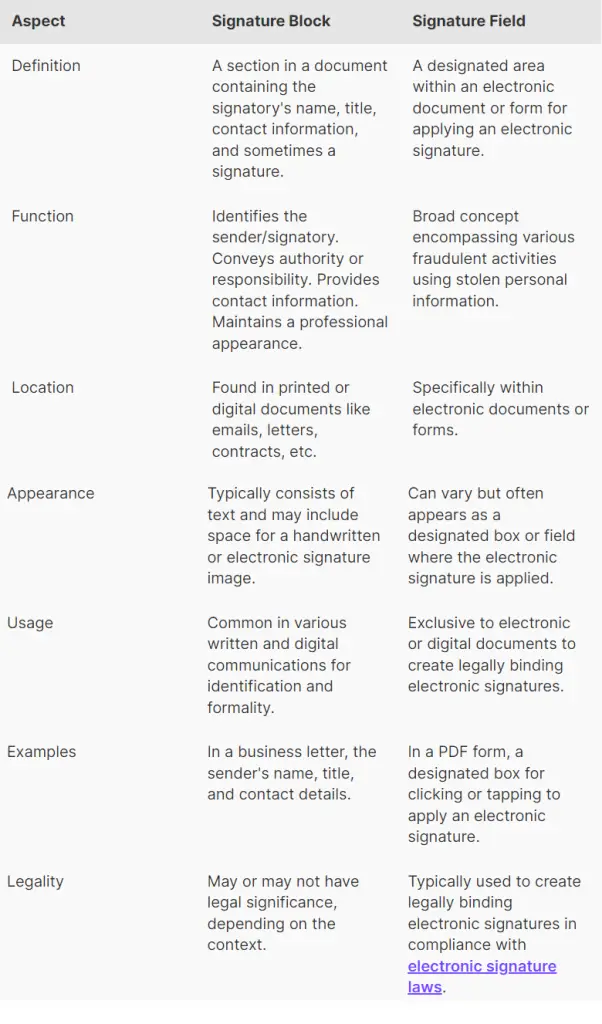
What is the Difference Between a Signature Block and a Signature Field?
“Signature block” and “signature field” have related but different purposes in document management and digital signatures:
Signature Blocks in Legal and Official Documents.
In legal and official documents — contracts, affidavits, court filings, and compliance records — the signature block takes on heightened importance. Here, it’s not just about professionalism; it’s about legal validity.
A legal signature block typically includes the full name, title, company, date of signing, and sometimes space for witnesses or a notary. The language within it often includes phrases such as “By signing below, I agree to the terms and conditions outlined in this agreement,” which directly ties the signature to legal obligation.
The exact format varies by jurisdiction and document type. For businesses operating across states or countries, ensuring your signature blocks comply with regional requirements — such as those outlined under the ESIGN Act and UETA — is critical to avoiding legal disputes.
An example of a signature block in a legal document would be:
______________________________
[Full Name of Signatory]
[Title or Capacity, if applicable]
[Company or Organization Name, if applicable]
[Date: ______________]
______________________________
[Signature of Signatory]
[Additional space for witnesses’ signatures, if required]
______________________________
[Full Name of Witness, if applicable]
[Title or Capacity of Witness, if applicable]
[Date: ______________]
______________________________
[Signature of Witness, if applicable]
[Notary Block, if notarization is required]
In this example:
- The full name, title, or title of the site and the name of the company or organization (if applicable) are included.
- There is space for the date of signing.
- The signer’s signature is placed on the line provided.
- If witnesses are needed, there is space for their full names, titles or abilities, dates, and signatures.
- If notarization is required, a separate notary block will appear below the signature block, where the notary can recognize and certify the authenticity of the signature.
Legal and official documents may also require specific language or clauses within the signature block to address legal requirements or conditions.
For example, you might find phrases like “By signing below, I agree to the terms and conditions outlined in this agreement.”
The exact format and content of signature blocks in legal and official documents may vary depending on jurisdiction, document type, and legal requirements.
Therefore, careful attention to detail and compliance with legal regulations are essential in these contexts to avoid potential conflicts or challenges.
Signature blocks in official documents are usually associated with senders. The block consists of the sender’s name, address, or company name.
Just to make all the content look more professional and trustworthy.
Types of Documents that use Signature Blocks
Signature blocks are used in a wide range of documents in various fields and serve a variety of purposes.
Here are some common document types where you’ll find signature blocks:
Contracts
Legal agreements, such as sales contracts, employment contracts, and lease agreements, use signature blocks to confirm the parties’ agreement and adherence to the terms.
Example: In a lease, the landlord and tenant sign the agreement in the signature box to acknowledge their acceptance of the terms of the lease.
______________________________
[Full Name of Party A]
[Title or Capacity of Party A, if applicable]
[Company or Organization Name of Party A, if applicable]
[Date: ______________]
______________________________
[Signature of Party A]
______________________________
[Full Name of Party B]
[Title or Capacity of Party B, if applicable]
[Company or Organization Name of Party B, if applicable]
[Date: ______________]
______________________________
[Signature of Party B]
Business Correspondence
Business letters and formal emails often include a signature block at the sender’s end, which enhances professionalism and provides contact information.
For example: A business email from a company executive might include a signature block containing name, job title, company, and contact information.
sincerely,
John Smith
Marketing Manager
ABC Corporation
Phone: (555) 555-5555
Email: john.smith@email.com
Legal Documents
Legal papers, including wills, affidavits, and power of attorney forms, require signature blocks to ensure the authenticity and authenticity of the document.
Example: A power of attorney form includes signature blocks for both the person granting the power of attorney and the appointed attorney.
_____________________________
[Full Legal Name of the Grantor/Declarant]
[Title or Capacity, if applicable]
[Date: ______________]
______________________________
[Signature of Grantor/Declarant]
[Notary Block, if notarization is required]
Financial Agreements
Financial documents, such as loan agreements, promissory notes, and investment contracts, rely on signature blocks to guarantee financial obligations.
Example: A promissory note contains a signature block of the borrower acknowledging the debt and terms of repayment.
_____________________________
[Full Name of Borrower]
[Title or Capacity, if applicable]
[Date: ______________]
______________________________
[Signature of Borrower]
Health Care Models
Medical consent forms, patient intake forms, and healthcare directives include signature blocks for patients and healthcare providers to support and confirm decisions.
For example: In healthcare directives, a patient signature block indicates informed consent regarding end-of-life decisions.
______________________________
[Full Name of Patient]
[Date of Birth: ______________]
[Date: ______________]
______________________________
[Signature of Patient]
______________________________
[Full Name of Healthcare Provider]
[Title or Capacity, if applicable]
[Date: ______________]
______________________________
[Signature of Healthcare Provider]
Forms of Government
Official government documents, such as tax forms, voter registration applications, and certificates, contain signature blocks to verify the accuracy of the information provided.
Example: Professional certification may require the candidate’s signature to confirm eligibility and acceptance of the certification requirements.
______________________________
[Full Name of Candidate]
[Certification Name: ______________]
[Date of Certification: ______________]
______________________________
[Signature of Candidate]
Academic and Research Works
In academic and research contexts, signature blocks may appear on research proposals, grant applications, dissertation submission forms, and academic certificates.
Example: An academic certificate contains a signature block for the institution’s representative and the recipient to verify the authenticity of the award.
______________________________
[Full Name of Author/Researcher]
[Academic Degree, if applicable]
[Institution/Organization: ______________]
[Date: ______________]
______________________________
[Signature of Author/Researcher]
Tired of chasing signatures on paper? WeSignature makes it easy to create secure, professional signature blocks and sign documents digitally — from anywhere, on any device. Start Your Free Trial — No credit card required.
Different Shapes of Signature Blocks
Signature blocks can take different formats to suit different document needs and communication styles.
Here are some common formats with examples:
Traditional Handwritten Signature Blocks
Traditional handwritten signature blocks typically include the signer’s wet signature as well as the date and position.
However, these signatures are vulnerable to forgery.
Therefore, sensitive documents require witnesses such as a notary before signing.
Example:
sincerely,
[Full Name]
[Title or Position]
[Company or Organization]
[Contact Information]
Digital and Electronic Signature Blocks
Electronic signature blocks, like email signature blocks, are created using digital solutions.
It allows you to create signature blocks and perform the signing process digitally from anywhere.
At the same time, it keeps the signing process secure using authentication methods such as biometric detection, encryption, and one-time password (OTP).
Example of a digital signature block:
/s/ John Doe
Example of an electronic signature block
—
John Smith
Marketing Manager
ABC Corporation
Phone: (555) 555-5555
Email: john.smith@email.com
What are the Benefits of Withholding a Signature?
Signature blocks offer many benefits in various forms of communication and authentication.
Here are some key benefits:
- Identification: Signature blocks help identify the sender or signer, making it clear who is responsible for the document or communication.
- Authentication: Provides a way to verify the authenticity of a document or message, reducing the risk of forgery or tampering.
- Professionalism: Including a well-designed signature set adds a professional touch to your documents and emails, enhancing their credibility.
- Contact Information – Signature blocks often contain contact details, making it easy for recipients to reach out for further communication or clarification.
- Legal Clarity: In legal and official documents, signature blocks are essential to identify the parties involved and their roles, which is critical to legal clarity and enforceability.
- Branding: In corporate communications, signature blocks can include company logos and brand elements, reinforcing brand identity.
- Efficiency: For electronic documents, digital signature blocks streamline the entire signing process — no printing, no delays.
- Consistency: Standardized signature blocks ensure that communications within an organization are standardized, maintaining a consistent and professional image.
- Compliance: In regulated industries like insurance, legal, and construction, signature blocks help ensure documents meet authentication and legal standards.
- Record Keeping: Make document management and record keeping easier by clearly indicating who signed the document and when.
Create your Signature Block with WeSignature
A well-designed signature block is a vital component of effective communication and document management. Not only does it identify the sender, but it also adds professionalism and credibility to your messages.
To simplify this process, consider using WeSignature, an easy-to-use digital signature solution that simplifies contract workflows and ensures secure, legally binding electronic signatures.After completing the wesignature login, you can quickly create, manage, and apply signature blocks across your documents.
With WeSignature, you can manage your documents effortlessly, improve your professional image, and save valuable time. Try WeSignature today and improve your contract workflow experience.
Start your free trial today and take control of your document workflow with WeSignature.
Ready to upgrade your document signing experience? Join thousands of professionals who use WeSignature to create legally binding signature blocks in minutes — secure, compliant, and completely paperless.Try WeSignature Free Today and take the friction out of every signature.
Frequently Asked Questions (FAQs) :-
**What is a signature block?**A signature block is a structured section placed at the end of a document, email, or form that contains the signer’s name, title, organization, contact details, and signature — handwritten or electronic. Its primary role is to identify the sender, authenticate the document, and present information professionally.
Is a digital signature block legally valid?
Yes. Digital and electronic signature blocks are legally valid when they comply with regulations such as the ESIGN Act, UETA, or eIDAS. Platforms like WeSignature ensure your signatures meet these compliance standards.
Can I create a signature block using free electronic signature software?
Yes. Many tools, including WeSignature, offer free electronic signature options that allow users to create basic signature blocks and sign documents digitally without printing or scanning.
What is the difference between a signature block and a signature field?
A signature field is simply where you place your mark. A signature block is the full surrounding section — it includes your name, title, company, contact details, and date, providing full context for who signed and why.
How does WeSignature help manage signature blocks?
After your WeSignature login, you can easily create, apply, and manage signature blocks across all documents — improving efficiency while maintaining security and a professional image. Learn more about our electronic signature solutions.